
Imagine your baby coming into the world in a tropical paradise, surrounded by jungle and warm air, on an island filled with genuine care and love and the kind smiles of the Balinese, while your postpartum recovery takes place at a villa with a wonderful view of greenery or the ocean and lovely humid air.

But beyond this pretty picture, a practical question comes up: is having a baby in Bali fantasy or reality?
You can give birth in Bali either at a private hospital with hotel-level service or at a natural birth centre with a midwife. The difference is not only in price: it lies in the approach to interventions, in the paperwork, and in what happens if something goes wrong.
What giving birth in Bali is like
The key thing for expats is the wide range of birth approaches to choose from. You can opt for modern, high-tech private hospitals (such as Siloam, BIMC or Kasih Ibu), which offer not only European equipment and comfort but also rooms with the service level of a good hotel.
As an alternative, the island also has unique centres such as Bumi Sehat, as well as specialists who offer the most natural birth possible, with minimal intervention and the support of experienced midwives.
Whatever you choose, be prepared: giving birth here means preparing your paperwork carefully and going into the details of your contract and insurance more deeply than you might in your home country.
Indonesian medicine has a higher rate of interventions, caesarean sections above all. So it is worth choosing an obstetrician-gynaecologist in advance — one who will support your birth plan: a natural birth or a gentle caesarean under the ERACS protocol.
Pay particular attention if you have:
- a multiple pregnancy, or a planned or possible preterm birth;
- risks of pre-eclampsia, gestational diabetes and similar conditions;
- a need for guaranteed access to a well-equipped NICU (neonatal intensive care) and paediatric subspecialists.
In such cases the plan is usually this: you should definitely be followed by a specialist and give birth at a large hospital with full intensive care, keeping “natural birth” centres only as an option for very low risk.
Postpartum paradise: the help you deserve
Giving birth in Bali means not only a mild climate and the ocean nearby, but also the chance to give yourself an ideal “fourth trimester”. The biggest practical advantage that expats often mention is the availability and relative affordability of help around the house or with the baby, and that matters so much for a mother in the first days and months.
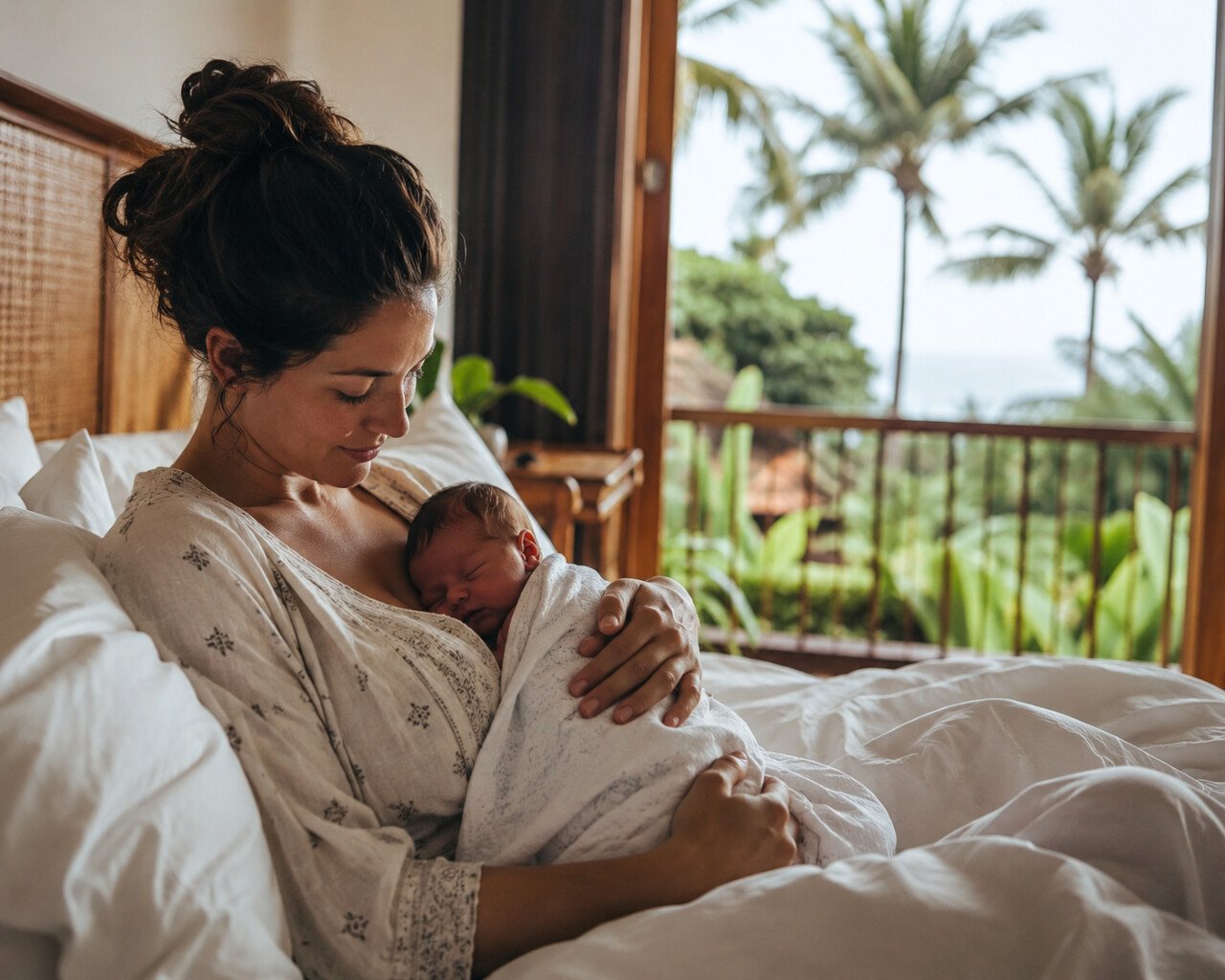
Unlike many Western countries, where nannies, cooks and helpers cost a fortune, in Bali you can hire a caring household helper who will take over the cooking and cleaning, or a nanny for a few hours a day or even overnight.
Being able to delegate chores and routine (the so-called housekeepers and cooks) lets you focus fully on recovery, breastfeeding and caring for your baby. You can also order ready meals from cafés and restaurants, so even if hiring a cook is not for you, cooking can be put off.
With this kind of support, the first months of parenthood turn into a real tropical holiday, where you can enjoy time with your child instead of an exhausting battle with dirty dishes and laundry.
Another pleasant and very practical advantage of life in the tropics: significant savings on baby clothes and, as a result, on laundry. Here you can forget about layered snowsuits, wool hats, warm blankets and piles of winter clothes that constantly need washing and storing.
A newborn only needs a light cotton sleepsuit, a bodysuit, or simply a nappy. This not only saves your budget and space in your suitcase, but also gives your baby an incredible sense of freedom and comfort.
How much a birth costs
Birth prices often depend on the package you choose, the type of room (standard or VIP), whether a caesarean is needed and whether there are complications. Holders of Indonesian documents (for example, KITAS) often get lower prices. The rupiah-to-dollar exchange rate can also affect the final amount.
According to the clinics’ official price lists, a natural birth at a dedicated maternity hospital costs from 8.5 million to 23 million IDR, and a caesarean from 13.5 million to 40 million IDR. The range within a single clinic comes from the room class, not the medicine. At the international hospital in Sanur the bill is several times higher.
The public hospital charges foreigners under a separate price list, and without local insurance it works out more expensive than the dedicated maternity hospitals — but with BPJS it is the other way round. An emergency caesarean after labour has already started costs roughly twice as much as a planned birth, so budget with a margin.
- RSIA Bali Royal (BROS): natural birth 8.5 million IDR in a third-class room and up to 19 million in the presidential suite, 2 days; caesarean 13.5–38 million IDR, 3 days.
- Puri Bunda Denpasar: natural birth 12 million IDR in a Drupadi room and up to 23 million in the Sita suite; caesarean under the ERACS protocol 17.5–40 million IDR. Stay — 2 days.
- Bunda Denpasar: natural birth package 15 million IDR, the same birth outside a package 23.5 million, with an epidural 35.2 million, emergency caesarean 55 million IDR.
- Bali International Hospital in Sanur: caesarean 41.3 million IDR in a standard room and 45.3 million in a Serenity room, 3 days.
- Prof. Ngoerah (formerly Sanglah): under the package price list for foreigners, natural birth 21.35–31.5 million IDR, caesarean 49.7–64.25 million IDR. The intimate birth package, with the baby delivered right in the room — 37.4 million IDR.
- Bumi Sehat in Ubud charges no fee but asks for a charitable donation: the suggested amount is around $1,000.
- An epidural is paid for separately, and the range is huge: at Puri Bunda they ask 2–5 million IDR for the anaesthesia and induction, while at Bunda Denpasar they quoted 20–35 million IDR. It is best to fix the amount in the contract before the birth.
- A consultation with an obstetrician-gynaecologist including an ultrasound costs 400 thousand to 1.2 million IDR depending on the clinic and the type of scan. A 4D screening at Bunda Denpasar costs about 1.17 million IDR.
- An appointment with an ultrasound at Bali International Hospital — 1.2 million IDR.
- An hCG test — from 848 thousand to 1.5 million IDR depending on the lab; some clinics ask for a doctor’s referral, and the consultation for it is paid separately.
- Vaccinations, tests for the baby and placenta disposal are usually not included in the package and are charged on top.
Where foreign women give birth: the most popular options
BIMC Hospital (Bali International Medical Centre)
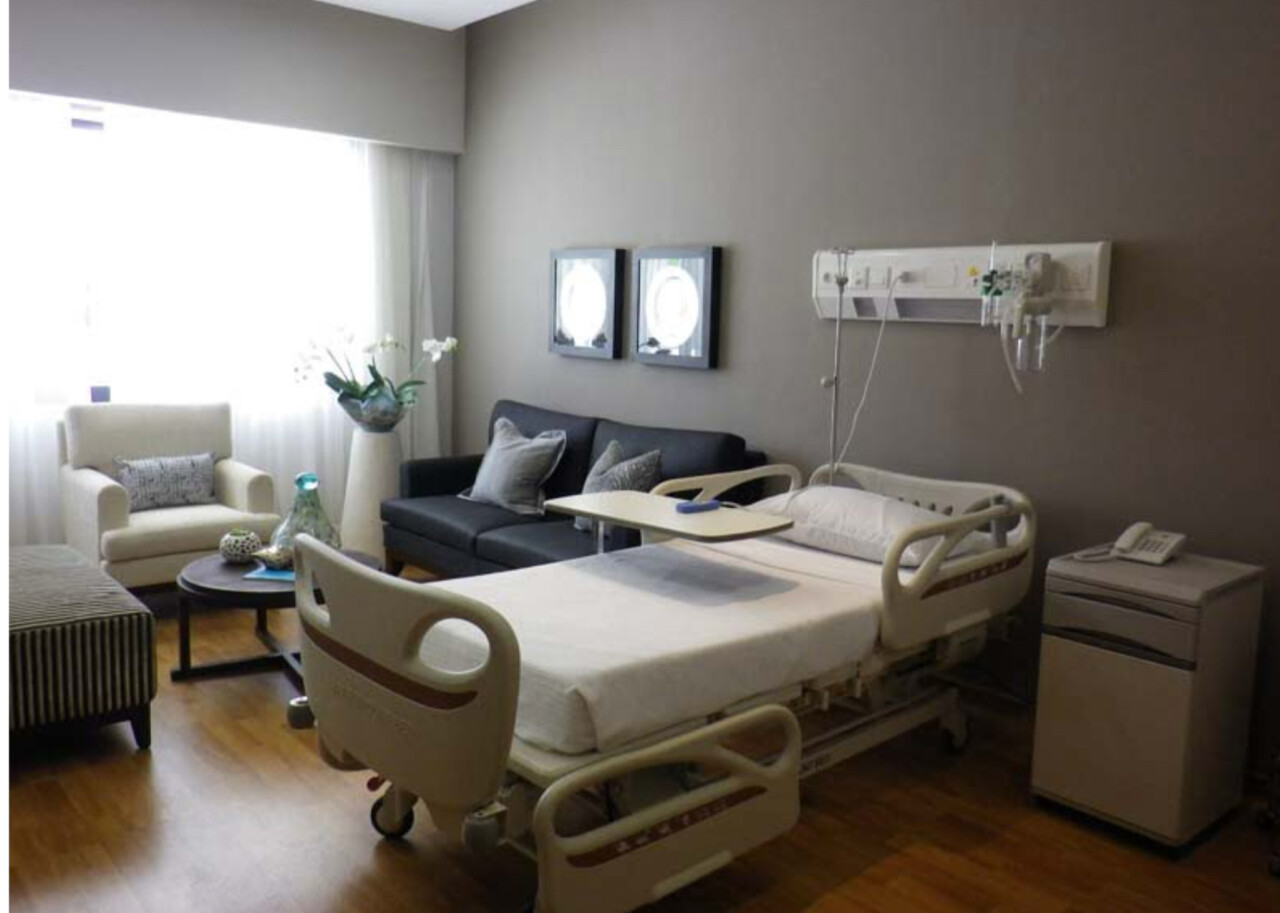
BIMC is often chosen by those looking for care as close as possible to Western or Australian standards. It is an international medical centre, and its services are aimed primarily at tourists and expats.
It is one of the most popular hospitals among foreigners: everyone here speaks English, from reception to the doctors, so there is virtually no language barrier.
The rooms are modern and often compared to five-star hotel rooms. The equipment is also noticeably newer than in most local clinics.
Services for expectant mothers:
- BIMC offers a full range of obstetrics and gynaecology services. As a large hospital, it has a strong base for emergency care and high-quality neonatal units (NICU), which matters for women with a higher-risk pregnancy.
- Doctors here are often open to an individual birth plan, but, as at other large private clinics, it is important to discuss support and a natural-birth approach in advance.
BIMC is the most expensive of the options listed: both the birth packages and individual consultations with tests cost more. In return, the clinic has direct contracts with many international insurers, and that makes payment noticeably easier for anyone with a policy covering childbirth.
BIMC does not publish a price list for births: the package is quoted on request for your specific due date, type of birth and room class.
The clinic suits those who value comfort, the absence of a language barrier and predictable dealings with an insurer — and who are ready to pay a premium price for it.
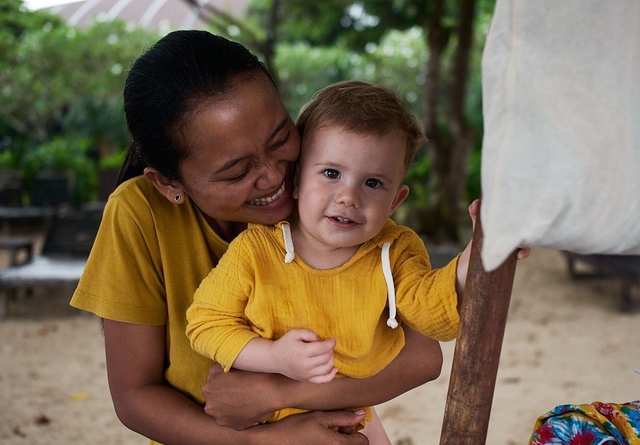
Puri Bunda
Contact: +62 361 419 860
Puri Bunda is a specialised mother and child hospital (Rumah Sakit Ibu dan Anak, RSIA): all its resources and staff are focused on obstetrics, gynaecology and paediatrics.
The hospital is in Denpasar, which makes it convenient for residents of every area (Ubud, Seminyak, Canggu, Sanur), though there is traffic at rush hour there too.
It is one of the most family-friendly options among the dedicated maternity hospitals: clear packages, decent English, obstetrician-gynaecologists on duty around the clock, and plenty of paediatricians on staff. Many of the doctors have busy practices and see expats.
If you are looking for a luxurious interior and five-star hotel service (as in some of BIMC’s VIP packages), Puri Bunda may feel like a more functional, no-frills hospital.
Always ask the hospital directly for the most up-to-date brochure with prices and the exact contents of the packages.
Birth options:
- Natural birth — 12–23 million IDR: 12 million for a Drupadi room, 13 million for Kausalya, 18 million for the Kunti suite, 23 million for the presidential Sita. The package includes two days in the room, doctor’s visits, basic tests, vaccinations for the baby, training in baby care and photos.
- Caesarean under the ERACS protocol — from 17.5 million IDR for a bed in a double room to 40 million for the presidential suite, with the same two-day stay.
- The birth can be paid for with insurance, with BPJS or in interest-free instalments under the clinic’s SiMantap programme.
The doctors are local but speak good English (usually good enough).
Although the caesarean rate in Indonesia is high overall, at this clinic you can find doctors who actively support natural birth plans when there are no medical contraindications.
Puri Bunda is a reliable, proven option for those looking for quality maternity care at a reasonable price at a specialised facility in Bali. It suits people who want to work out the budget for the whole process in advance.
Puri Bunda has branches in Tabanan and Singaraja, and since December 2024 it has also run RSIA Cendana Premier in Peliatan near Ubud — the first maternity hospital in Gianyar, with 29 beds and 15 specialist doctors. The Tabanan branch is newer than the Denpasar building, but epidurals are not available there for natural births.
Bali Royal (BROS)
Contact: +62 361 247 999
Bali Royal Hospital (BROS) is a large private mother-and-child hospital with modern birth protocols and its own neonatal intensive care unit (NICU). The maternity and paediatric services are housed in a separate building, RSIA Bali Royal at Jl. Tantular Barat, 80 in Renon: it holds the delivery unit, intensive care, a children’s centre and an IVF clinic.
It is located in Denpasar and is known for its high level of service and for specialising in various areas of medicine besides obstetrics. This option works if you want a private clinic but also need neonatal intensive care on site.
It is worth noting that the number of beds here is limited, so it is better to check and arrange everything in advance for your due date.
The clinic publishes its prices openly: natural birth — from 8.5 million IDR in a third-class room to 19 million in the presidential suite, two days; caesarean — from 13.5 million to 38 million IDR, three days. Sterilisation and multiple births are charged separately and cost more. The staff speak Indonesian and English.
Services for pregnant women and mothers-to-be:
- Comprehensive pregnancy care: BROS offers pregnancy monitoring programmes including regular consultations, lab tests and ultrasound scans.
- Birth: They provide both natural birth and caesarean section. Many foreigners note the high level of comfort in the postnatal rooms.
- Staff: the hospital employs many well-known and experienced obstetrician-gynaecologists in Bali, some of whom have experience with expats and speak English.
- NICU (neonatal intensive care unit): BROS is a large hospital with the equipment needed to care for newborns, including premature babies or those with health problems. That is an important factor for mothers who worry about potential risks.
In terms of price, BROS is comparable to Kasih Ibu and noticeably cheaper than BIMC and Siloam.
Like most clinics, BROS offers birth packages at different prices depending on: the type of birth (natural/caesarean), the length of stay (usually 1-2 nights for a natural birth and 2-3 nights for a caesarean) and the room class (Standard, VIP, Suite).
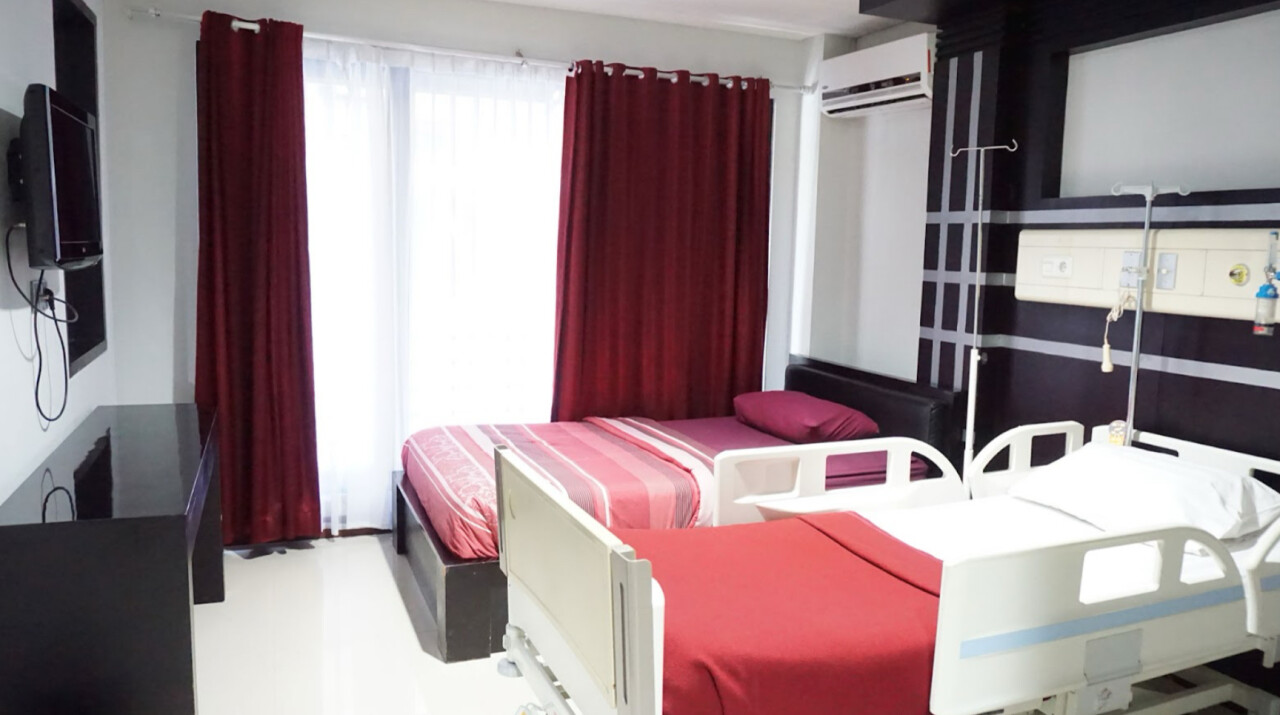
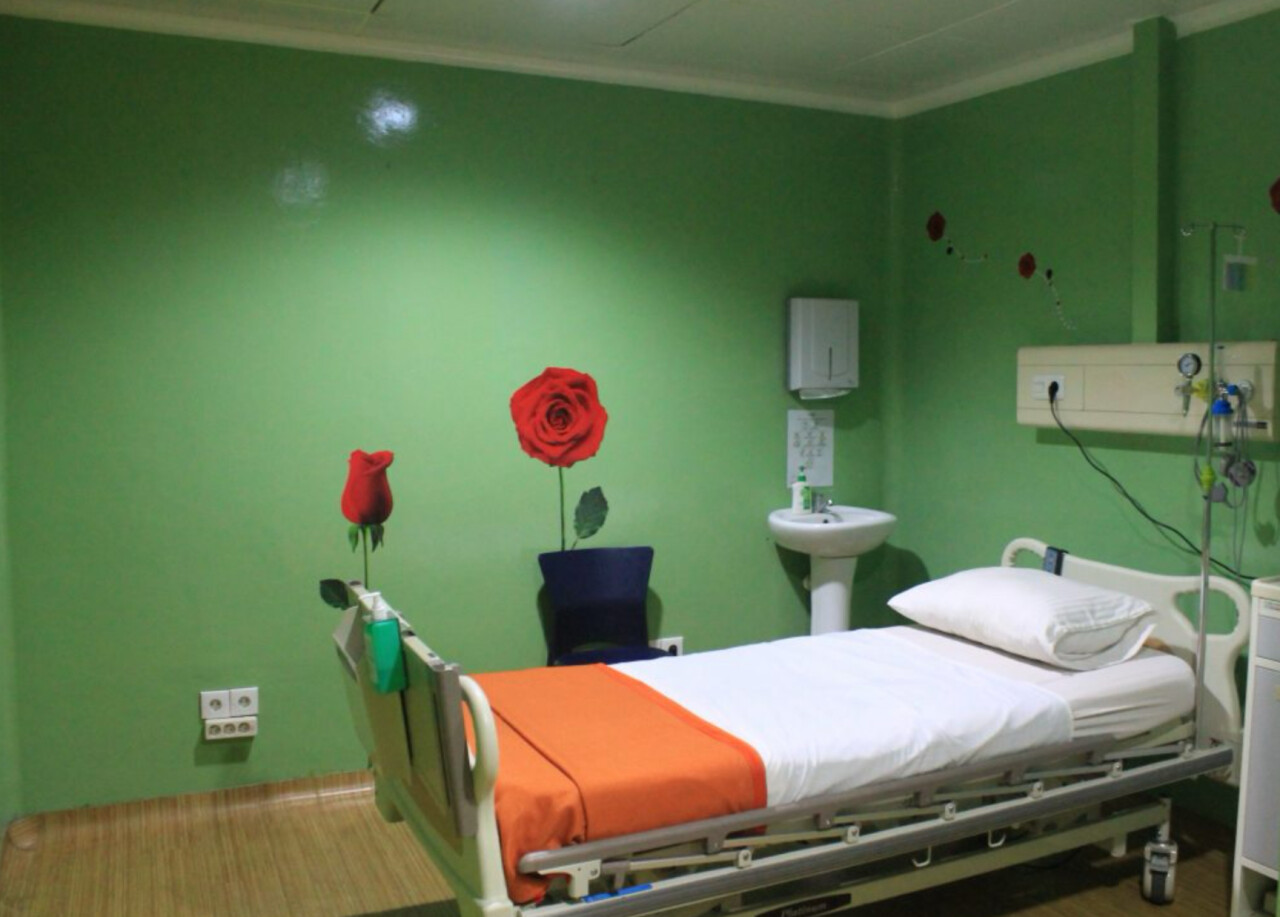
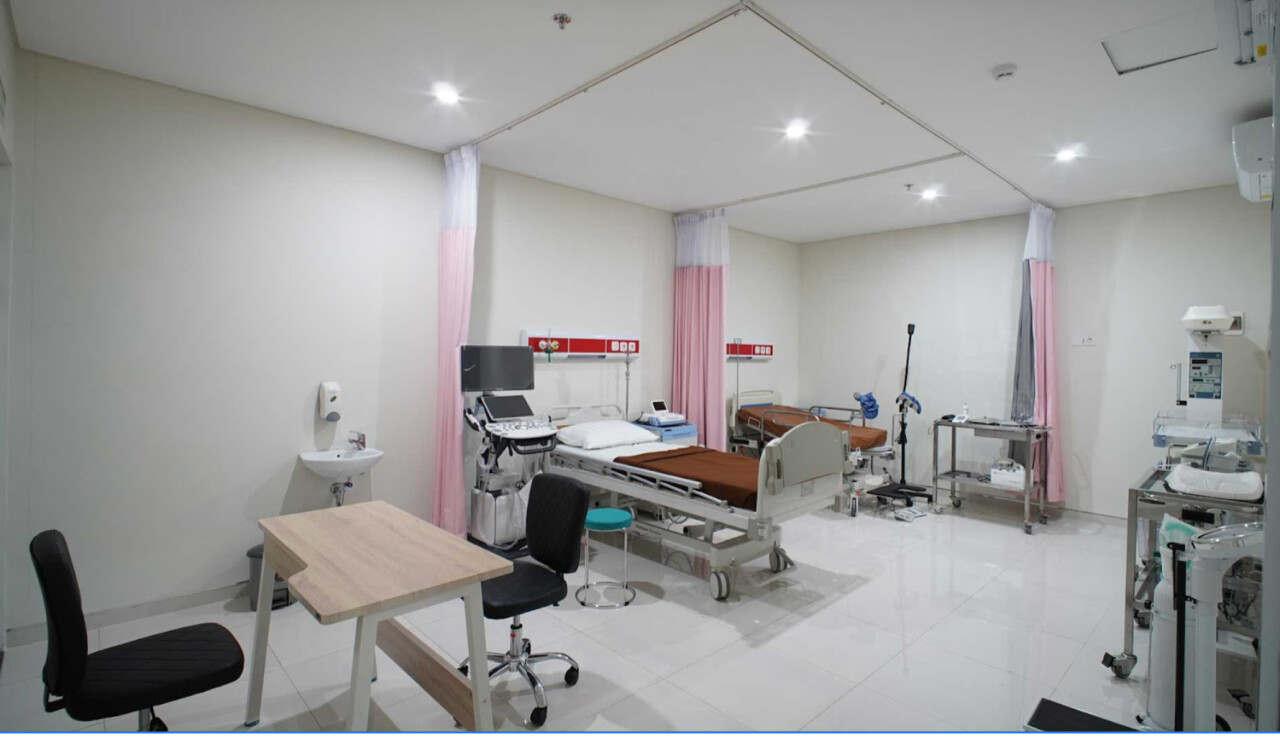
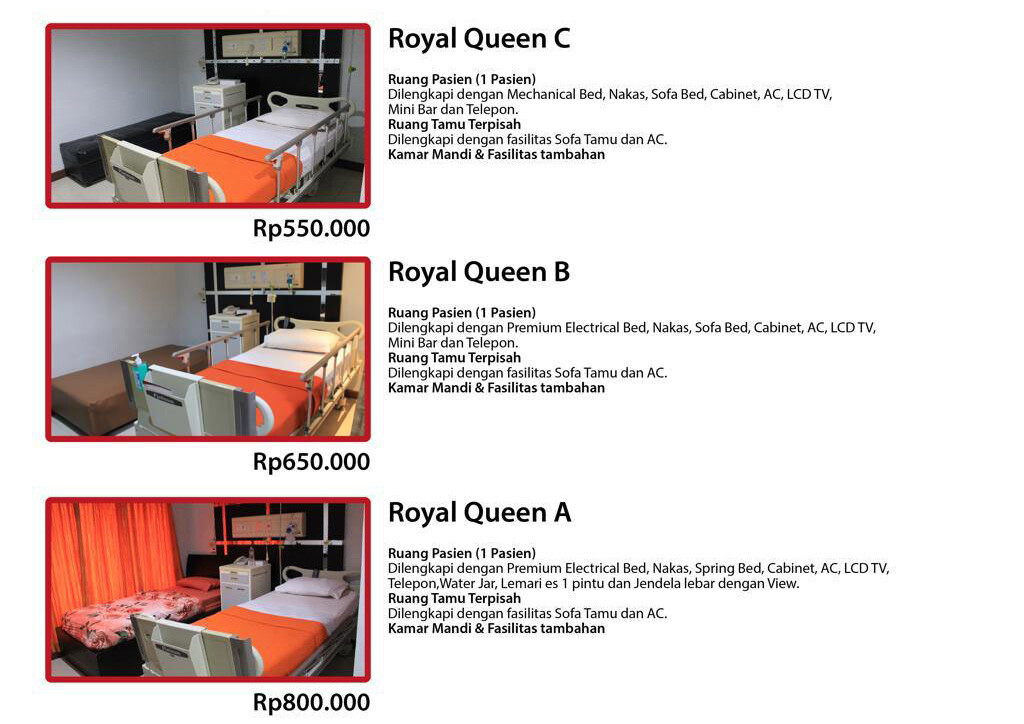
Rooms for mothers. Photo from baliroyalhospital.com
RSIA Bunda Denpasar
Contact: +62 361 844 5900
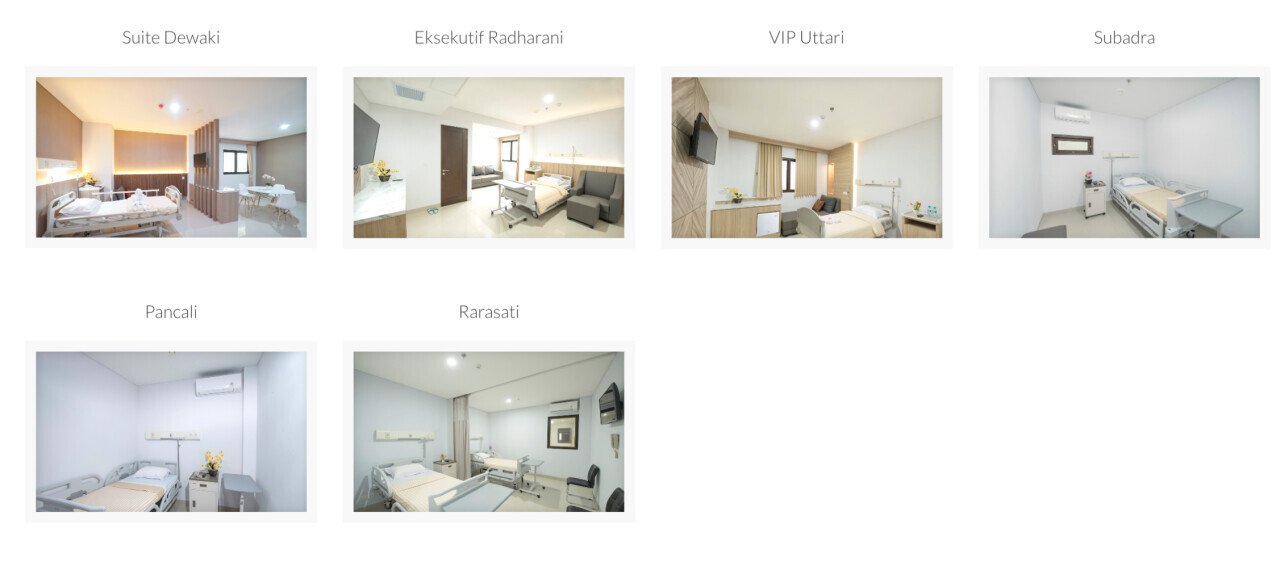
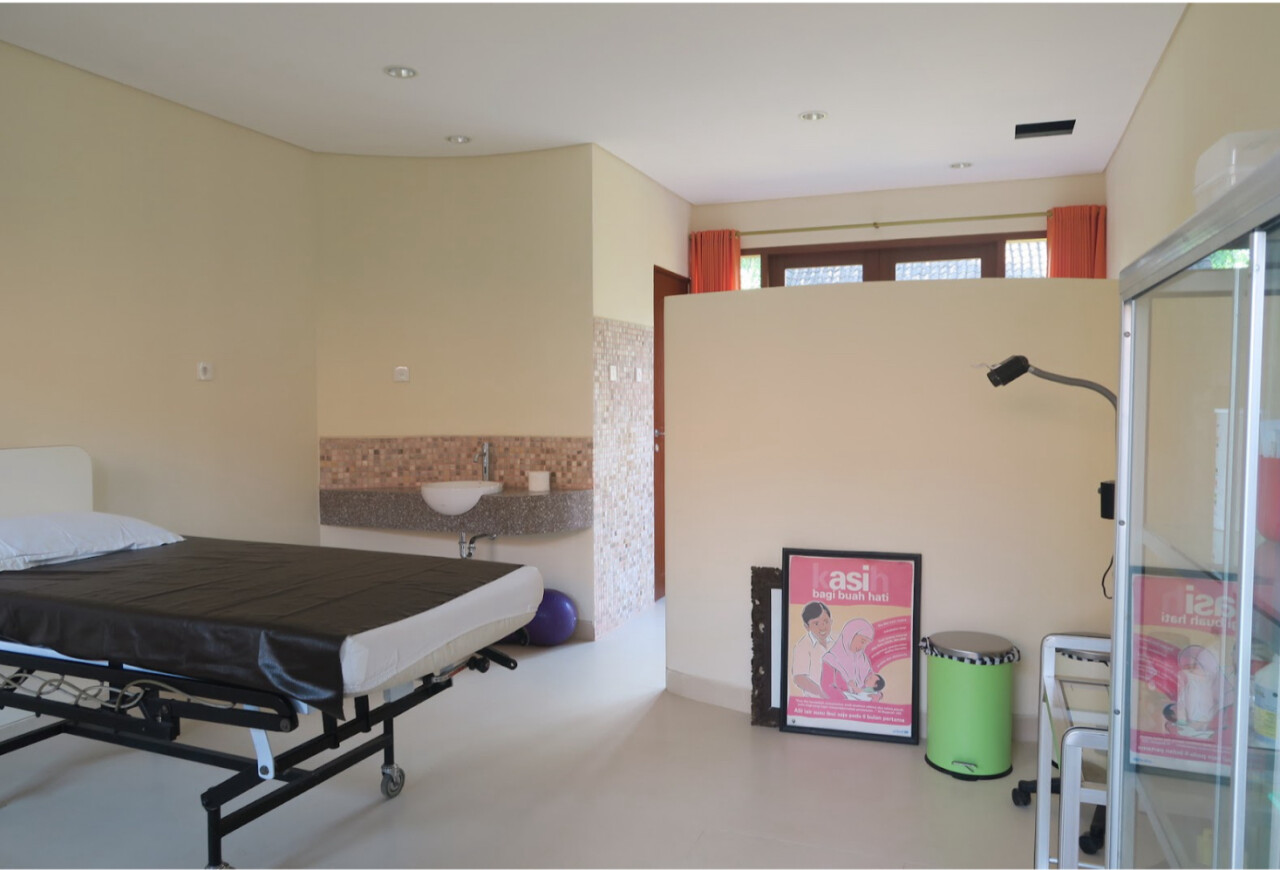
Bunda Denpasar is a relatively new clinic with a very good fit-out, modern equipment and comfortable rooms and delivery suites.
Among expats the clinic is valued for how well its paediatric unit is equipped and for its reasonable prices.
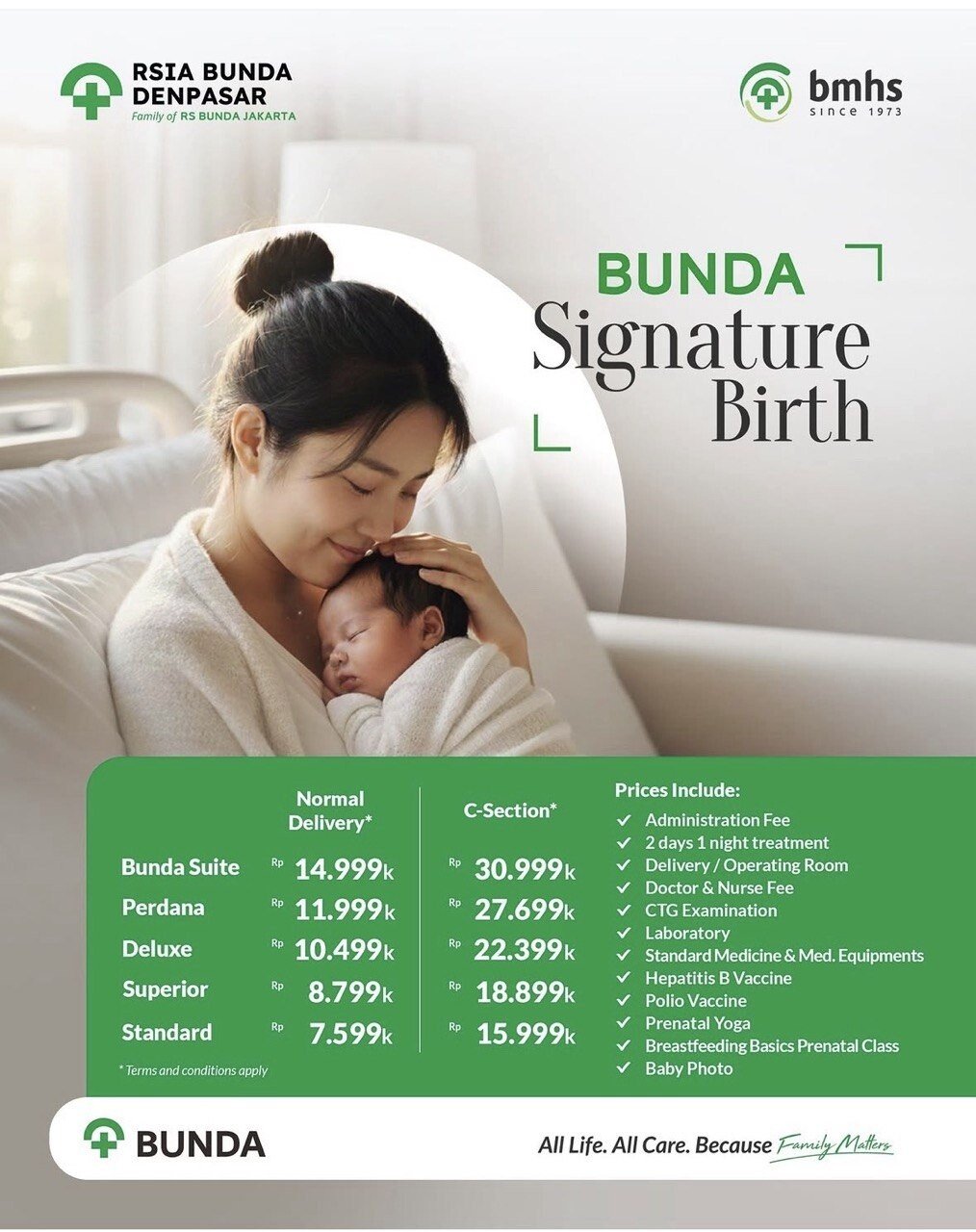
- fixed packages for natural birth and caesarean, with the price depending on the room category;
- the clinic quotes the following prices: natural birth package 15 million IDR, birth outside a package 23.5 million, with an epidural 35.2 million, emergency caesarean 55 million IDR;
- there is only one delivery room at the clinic, so it is worth discussing the date and the room class in advance.
The rooms here are among the newest of the specialised maternity hospitals in Denpasar, and there are fewer births than at Puri Bunda — mothers say the staff pay closer attention. That said, reviews about the bill differ: some praise the fixed packages, others complain that they only found out the final amount at discharge.
Bunda Denpasar is a modern, comfortable and reliable maternity hospital that combines a specialised approach, a high level of equipment and reasonable prices.
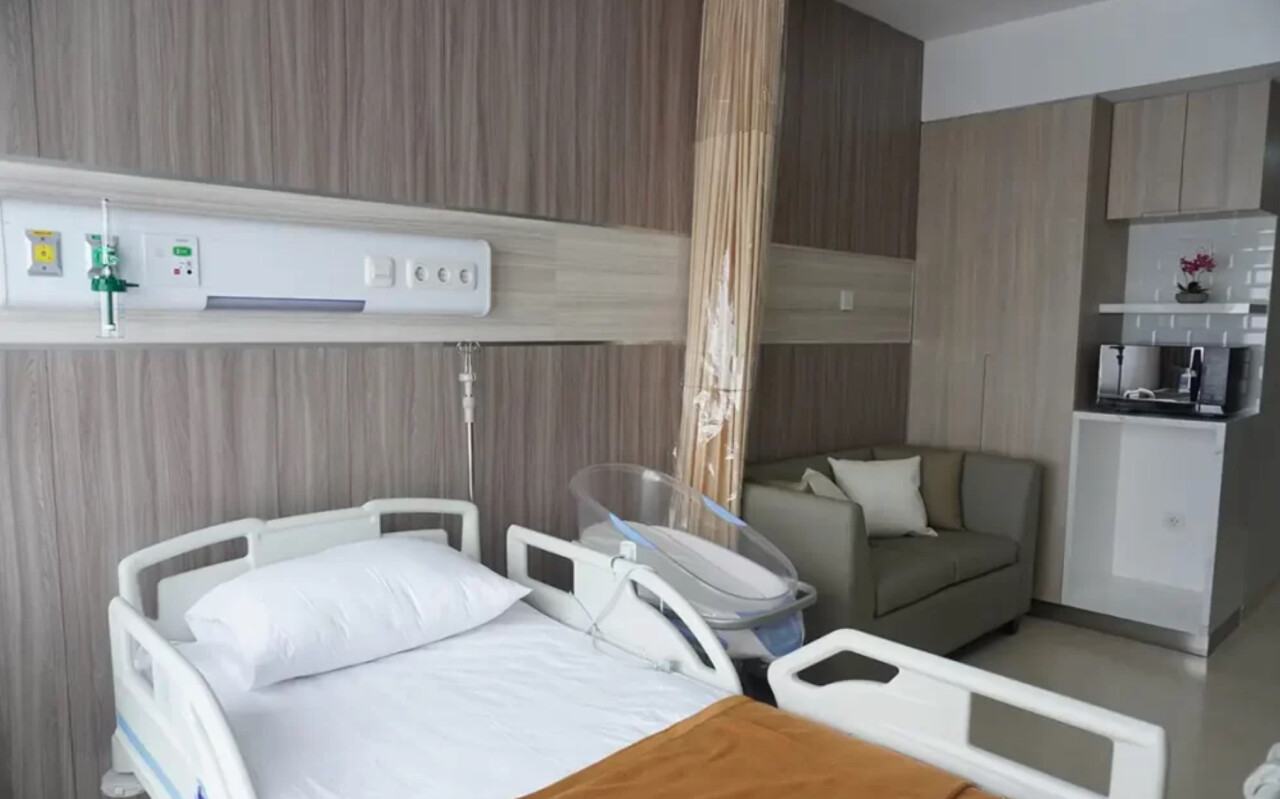
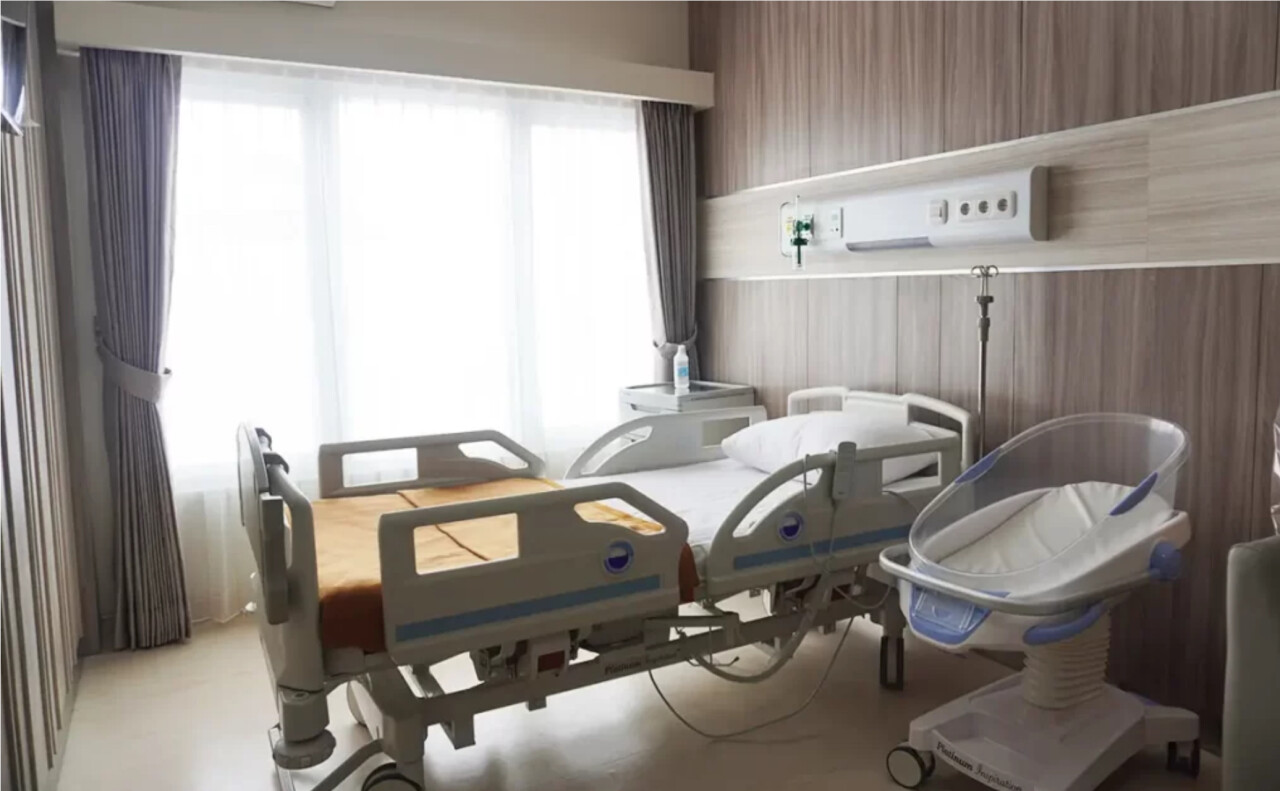
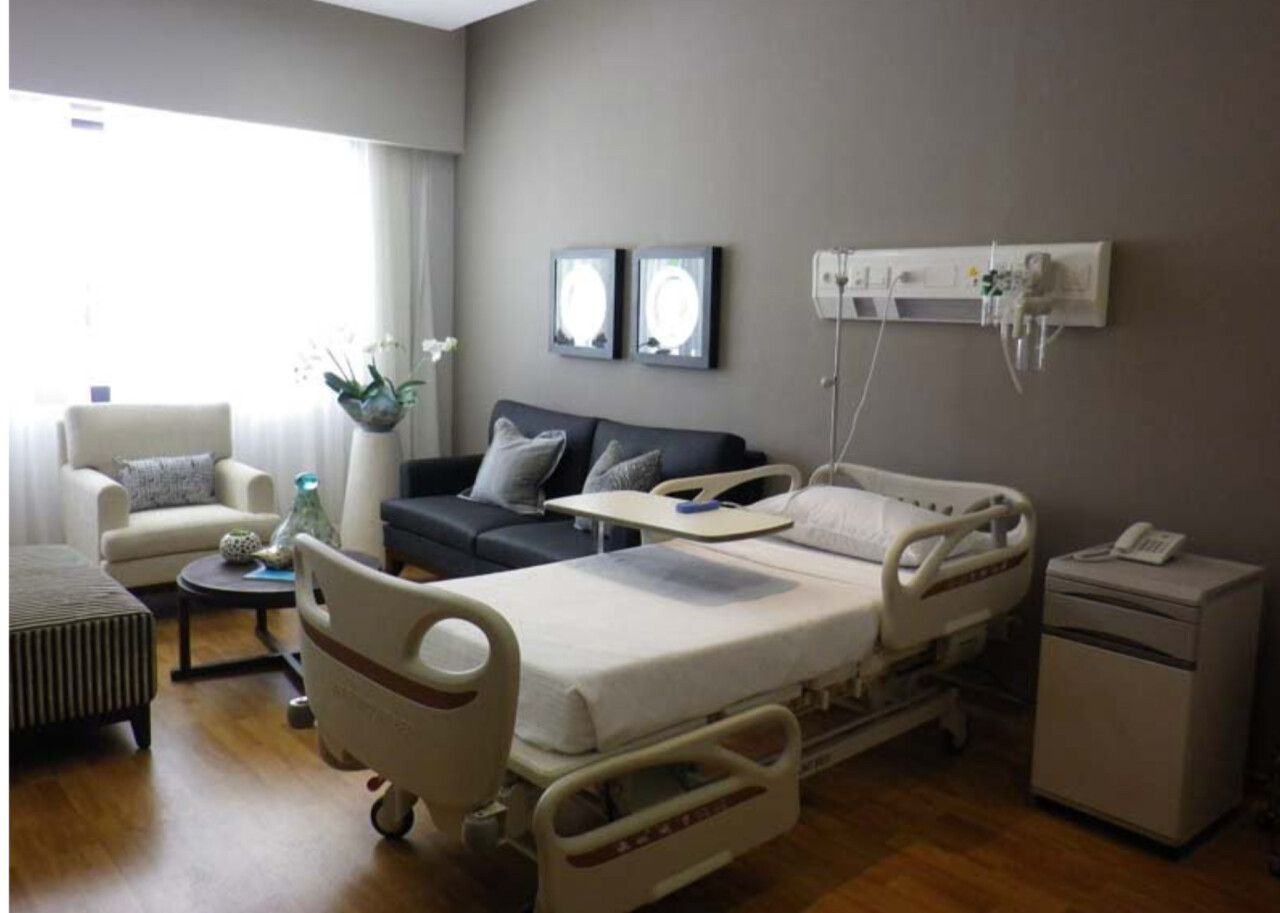
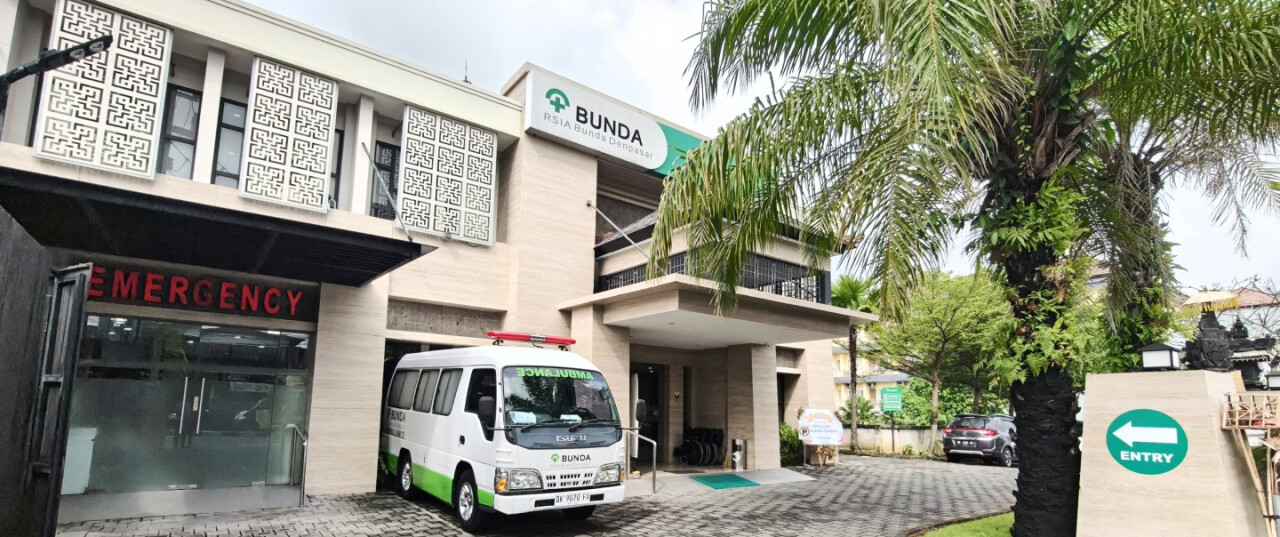
A VIP room and a Suite at the clinic. Photo from bundadenpasar.com
KIA at Prof. Ngoerah (formerly Sanglah)
Contact: +62 361 244 030
Prof. Ngoerah is the island’s largest public hospital and the referral point for all complex cases. It has adult and paediatric intensive care and specialist teams on duty around the clock, so the approach to childbirth differs noticeably from private clinics.
The most complex, serious and high-risk cases from all over the island and the neighbouring islands are sent here.
In September 2024 a separate mother and child building (KIA) opened here: five floors, 326 beds, a children’s outpatient clinic, delivery rooms and operating theatres for caesareans. The building cost 233 billion rupiah and is designed for the most serious cases — they care for premature babies weighing less than a kilogram and children born before the 28th week. There is no neonatal intensive care of this level anywhere else on the island.
Paid births go through the Wing Amerta wing: its own outpatient clinic with ultrasound, appointments Monday to Saturday from 8:00 to 20:00, and VIP and VVIP rooms. For foreigners the mother and child building publishes a package price list — these are prices for people paying themselves, without BPJS. There are three room classes to choose from, with a 30% deposit.
- Natural birth — 21.35 million IDR in a VIP room, 23.8 million in VVIP and 31.5 million in a Suite. The package covers two days and one night.
- A birth with complications — 28.35–38.5 million IDR, twins delivered naturally — 34.5–46 million IDR.
- Caesarean — 49.7 million IDR in VIP, 54.1 million in VVIP and 64.25 million in the Suite, three days and two nights. Under the ERACS protocol — 51.45–64.8 million IDR, but the stay is shorter: two days and one night. Twins by caesarean — 59.5–77.2 million IDR. Sterilisation during the operation adds 4–5 million IDR to the bill.
- An epidural — 6.825 million IDR on top of the package, in any room class.
- Intimate birth, where the baby is delivered right in the room, is available only in VVIP and costs 37.4 million IDR. If such a birth has to end in a caesarean, the bill rises to 54.1 million IDR.
The package prices are calculated for a birth without complications: resuscitation of the mother or the baby, ICU and NICU are charged separately. The amount is fixed on the day of the procedure — if you are admitted before the scheduled date, the days before the birth are paid on top of the package.

The paediatric part includes the hepatitis B vaccination in the first hours and screening for congenital hypothyroidism. The husband may be present both in the delivery room and in the operating theatre, and filming the birth is allowed with separate written consent.
The downsides:
- the new mother and child building does not do away with the general flow of patients: paperwork, referrals and examinations at a public hospital take longer than at a private one;
- the language barrier: specialist doctors speak English, but nurses and support staff have weaker English, and an interpreter may come in handy.
The hospital works with BPJS — the public insurance you apply for with a KITAS. With it, the birth, prenatal care and treatment cost far less than the package price list, and some cases are covered in full: this is where the public hospital beats any private clinic. You can upgrade the room class for an extra fee, but only up to VIP: VVIP is not available under the insurance. Scheduled visits require a referral from the clinic you are registered with (FKTP); in an emergency no referral is needed.
Processes at a public hospital are more formal and take more time — worth keeping in mind if you arrive already in labour.
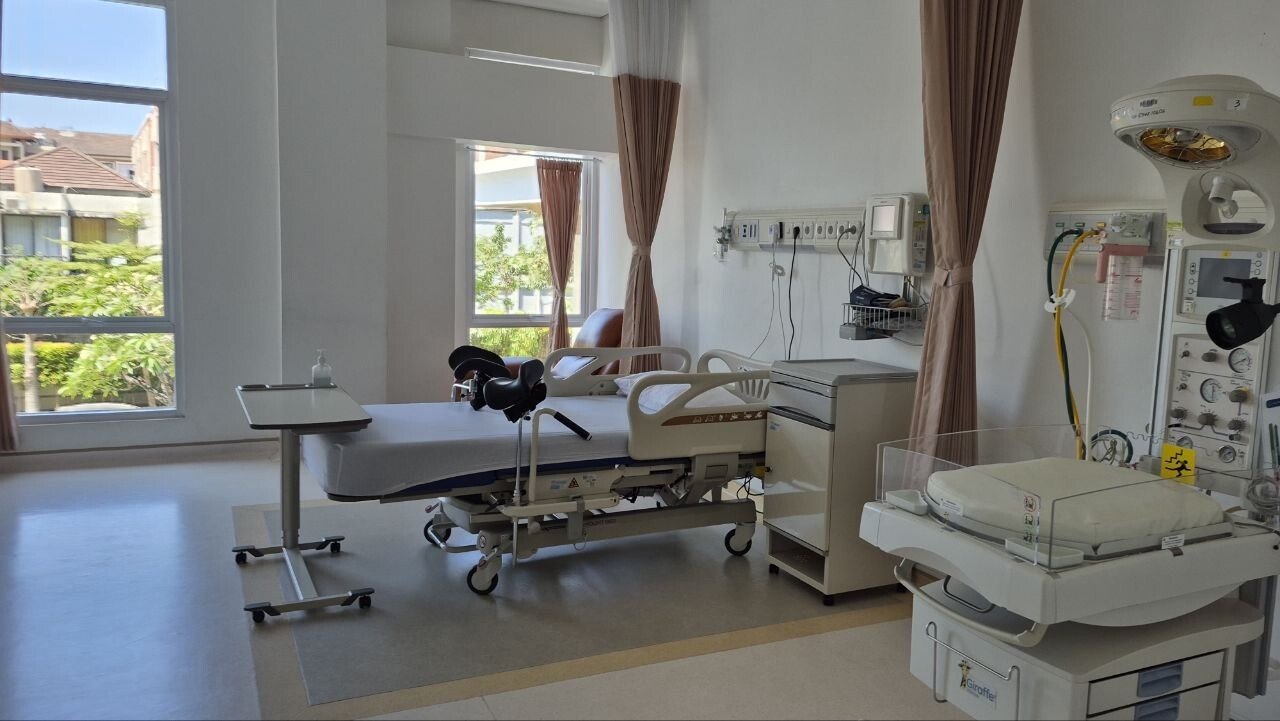
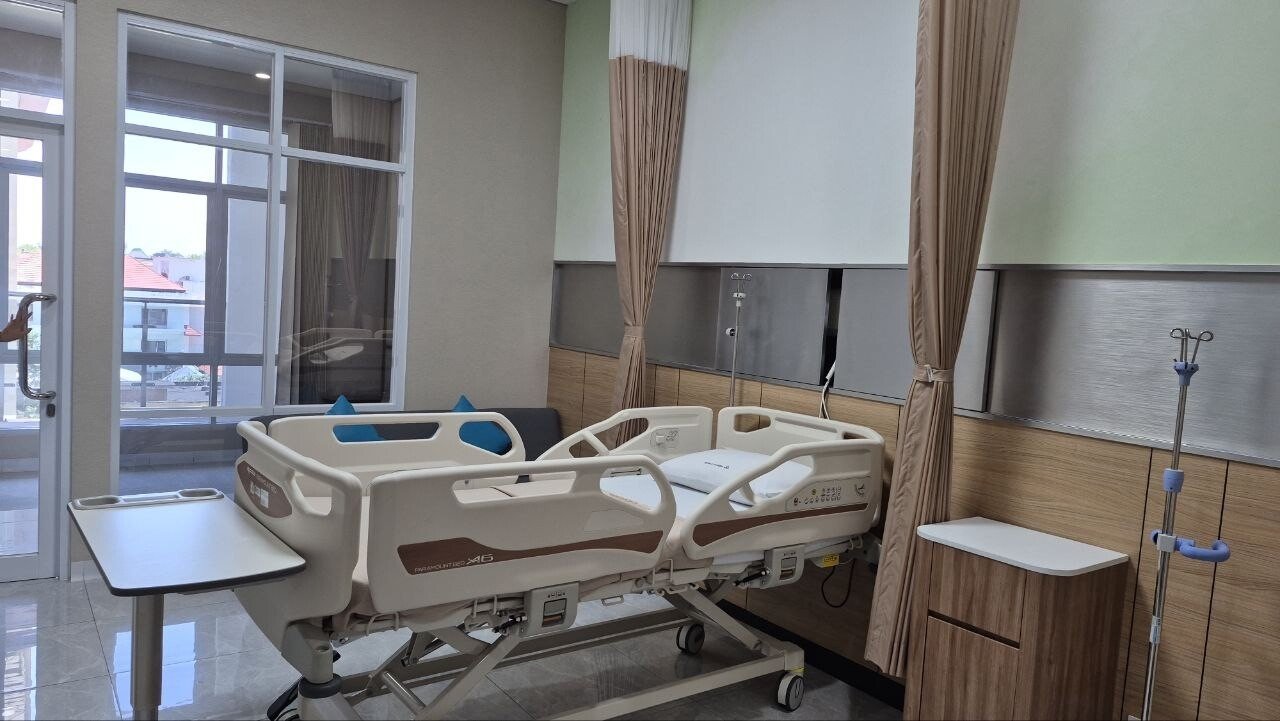
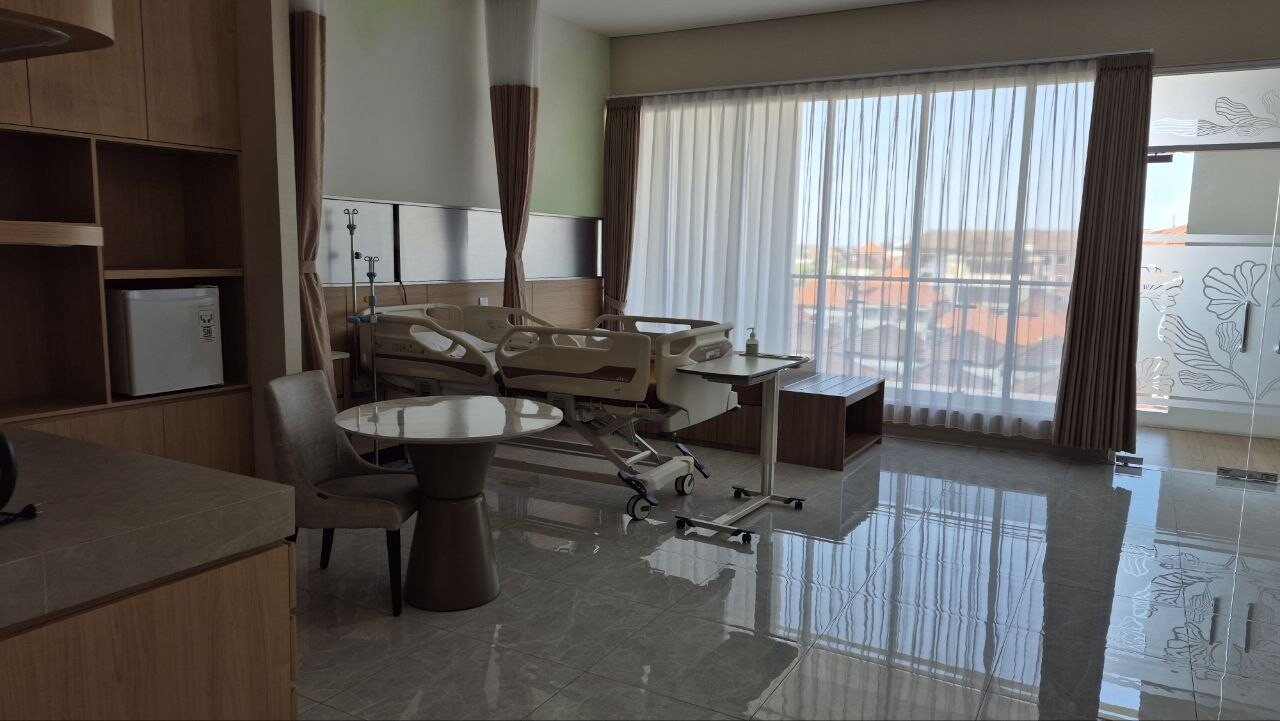
View 1
more photo
more photo
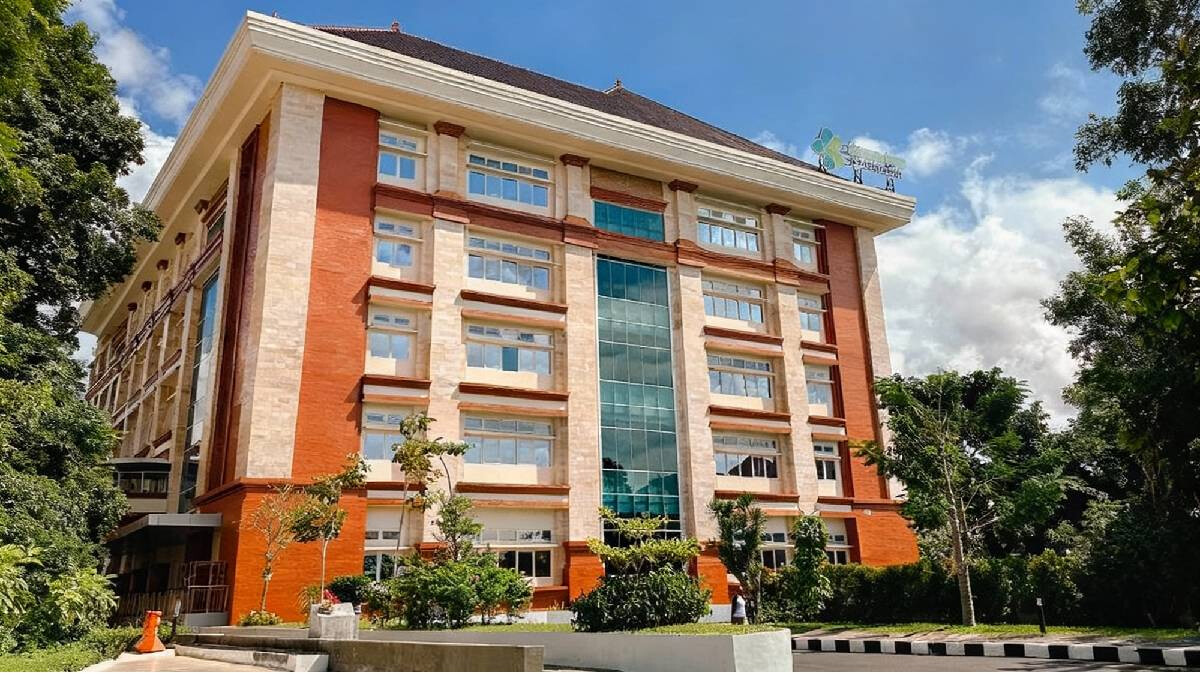
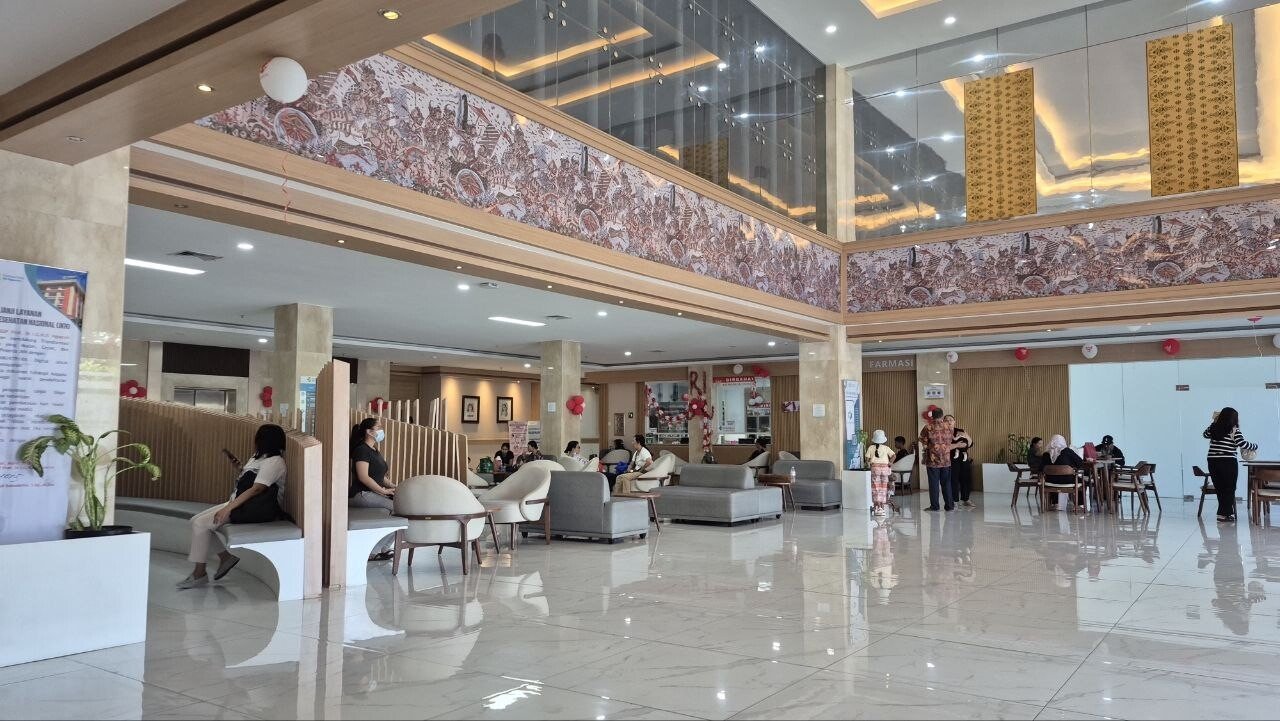
The Prof. Ngoerah mother and child building: the hall, a VIP delivery room, VIP and VVIP rooms, and the postnatal ward lobby. Photo: BaliForum
Kasih Ibu Hospital
Contact: +62 361 3003 030
(Denpasar / Saba / Kedonganan / Tabanan)
Kasih Ibu is one of the oldest private hospital groups in Bali, and it started out as a maternity hospital. It has several sites around the island, a wide range of diagnostics, intensive care and a great deal of experience with foreigners.
They provide prenatal care, deliver babies, perform caesareans and offer postnatal support.
There are dedicated departments. Prices depend on the branch and the room class; packages are provided on request. The languages are Indonesian/English (+ the group often has Japanese-language customer service).
For births the Denpasar branch is chosen most often; births are also handled in Tabanan, Kedonganan and Saba. The clinic is popular with expats thanks to its reputation and level of service.
The hospital is multidisciplinary, but a great deal of attention goes to mother and child care here: prenatal care, natural birth, caesarean and neonatal intensive care (NICU) if needed.
The hospital is known for its cleanliness, modern equipment and, above all, comfortable rooms. Many mothers say the rooms here are very cosy and well equipped.
On price, Kasih Ibu sits in the middle of the market: more expensive than the dedicated maternity hospitals, cheaper than BIMC and Siloam. The birth packages are fixed and cover the stay, the doctor’s work and care; the price depends on the type of birth and the room class. Discounts apply with a KITAS.
This is an excellent choice for anyone looking for a high standard of medical care, comfort and reliability at a private hospital, and who is ready to pay above-average but not top-end prices.
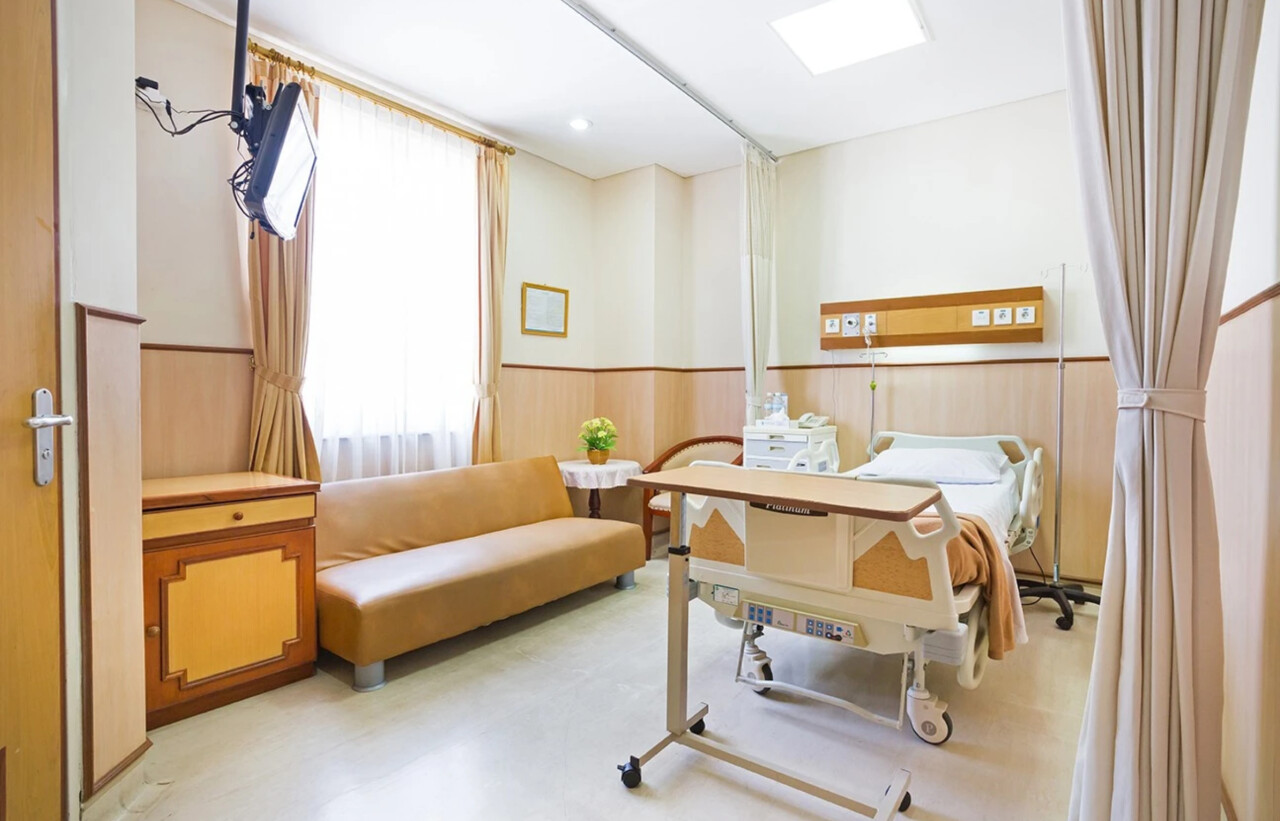
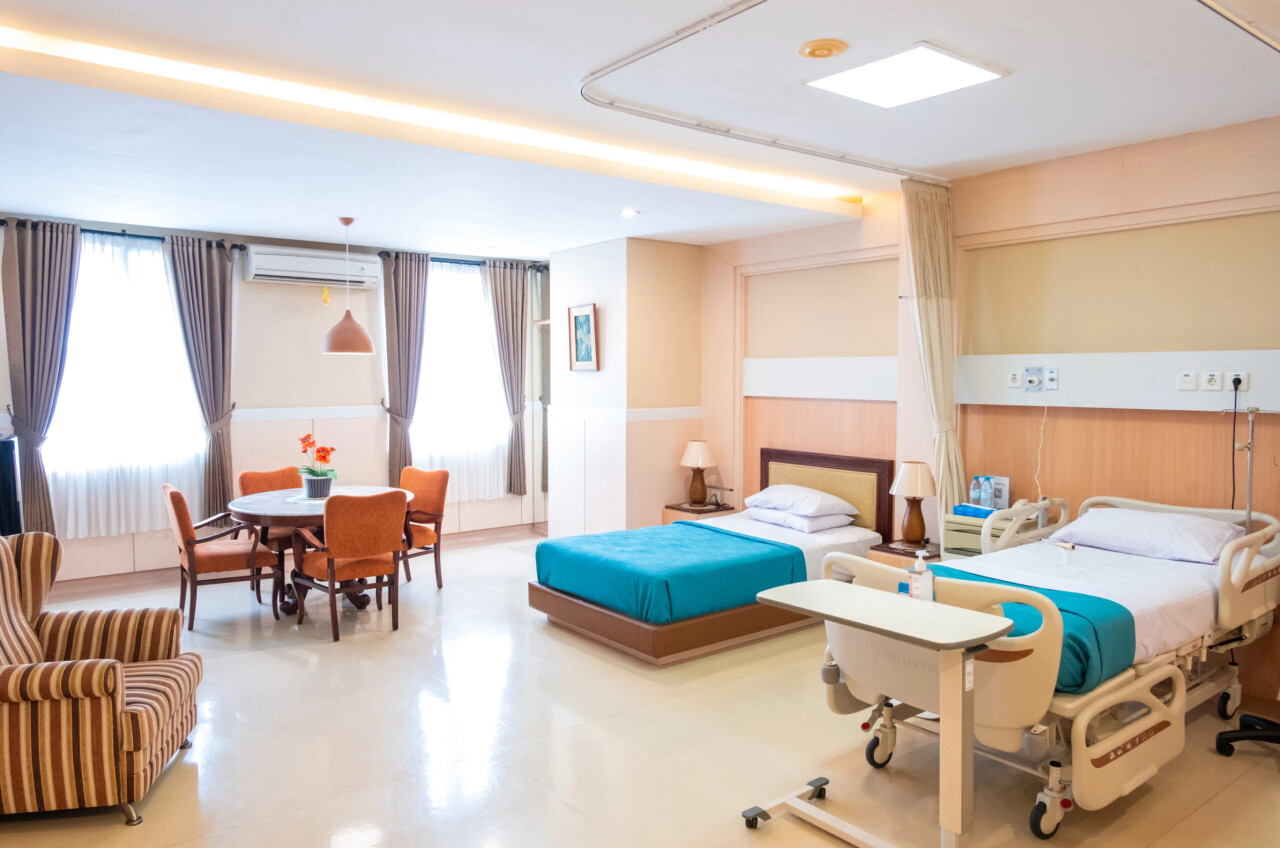
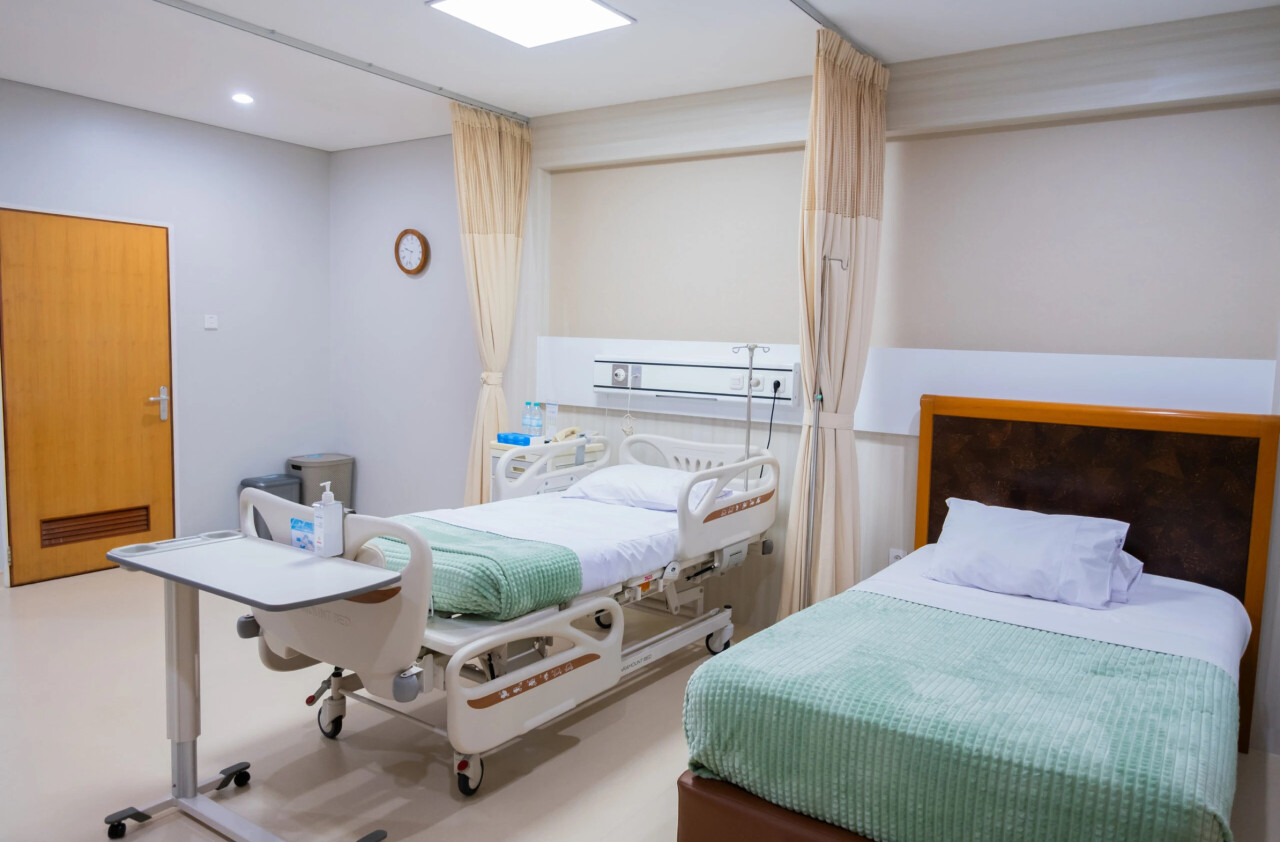
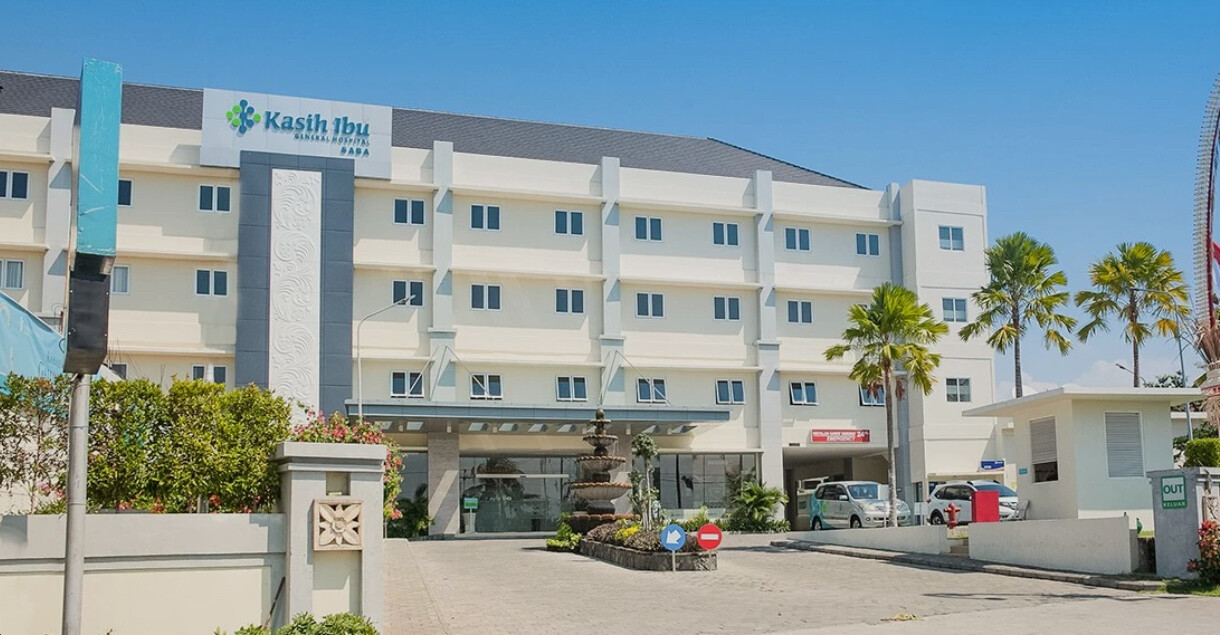
Rooms for mothers. Photo from the site kih.co.id
Bali International Hospital (Sanur)
The newest hospital on the island: Bali International Hospital has been operating since April 2025 and was officially opened in June 2025 along with the special health economic zone in Sanur. It has 255 beds, eight operating theatres, 38 intensive care beds and a partnership with the American Mayo Clinic.
The obstetrics department has a fetal-maternal specialisation — that is, pregnancies with risks and complex diagnostics. There is natural birth with and without an epidural, caesarean, caesarean under the ERACS protocol, breastfeeding support and classes for parents.
This is the most expensive option on the island. The clinic publishes its caesarean prices openly: 41.3 million IDR in a standard room and 45.3 million in a Serenity room, three days. A natural birth here costs more than a caesarean: the clinic quotes mothers 51–70 million IDR depending on the room and the anaesthesia. An appointment with an ultrasound — 1.2 million IDR.
Yayasan Bumi Sehat
Contact: +62 361 974 615
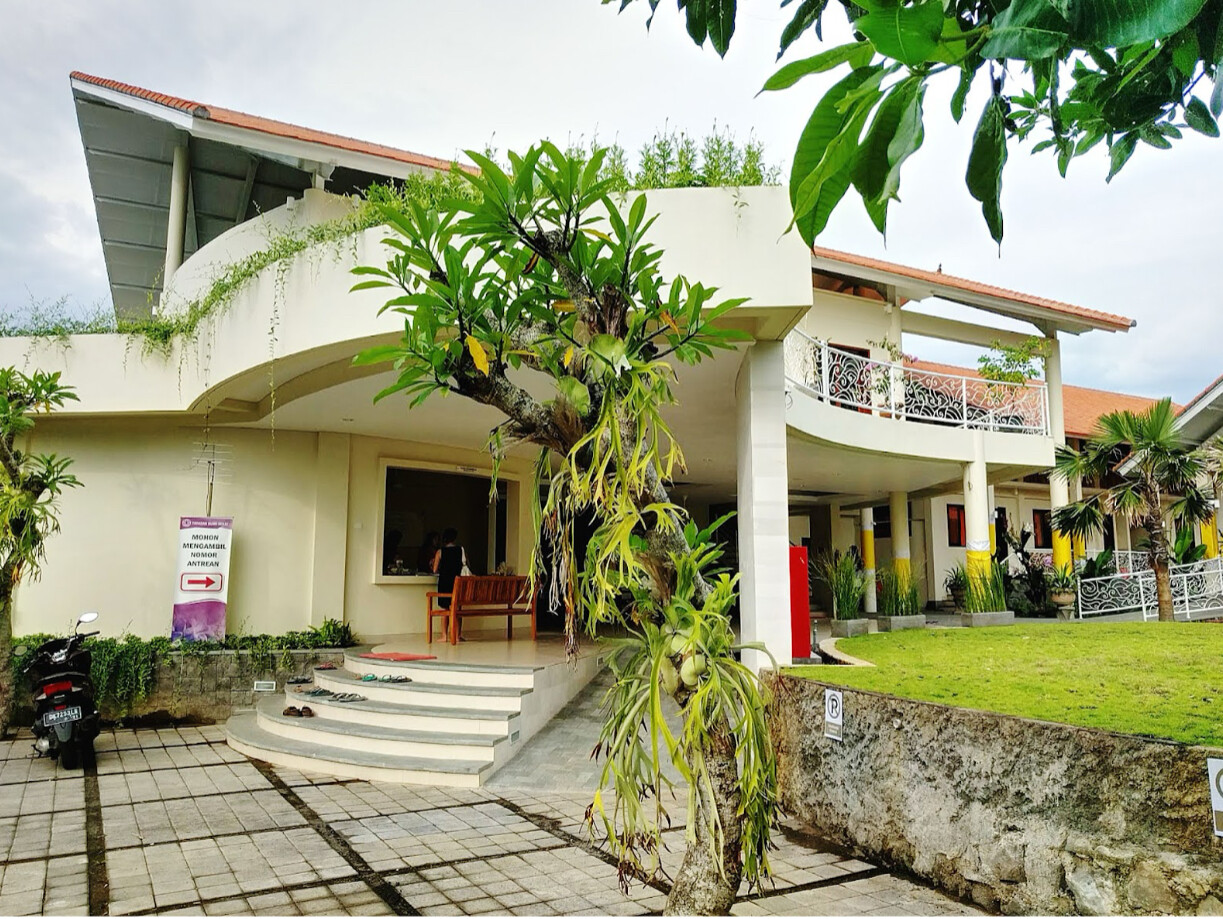
Bumi Sehat is not a hospital in the usual sense but a charitable foundation created by the American midwife Robin Lim. It is a world-famous natural birth centre in Nyuh Kuning near Ubud: lotus births, births with a doula, gentle protocols and postnatal support.
The foundation’s story began with tragedy and deep compassion: Robin, who had lost her sister and her mother in childbirth, devoted her life to making maternity care safe, affordable and humane, especially in developing countries. After the earthquake and floods in Indonesia she realised how badly women need help that does not depend on their wallet.
Robin Lim is a mother of eight children and a professional midwife with vast experience, and she understands how much our world depends on the kind of people who will inhabit it and shape it.
The clinic’s concept is birth as a natural process.
Bumi Sehat follows the philosophy of “minimum intervention, maximum care”.
First, the umbilical cord is not cut straight away. The midwives let it finish pulsing so that the blood, iron and stem cells return to the baby’s body: cutting the cord early is seen here as needless stress for the newborn.
Second, at the Bumi Sehat clinic births are handled as naturally as possible — without inducing labour with oxytocin injections, without surgery, without an epidural. The idea is that everything goes the way nature intended, as naturally as possible. But under the careful watch of experienced midwives. Yes, births here are attended by trained midwives rather than obstetricians, and that is the key difference from hospitals. This is a place where the woman gives birth herself, rather than having someone "deliver" her.

Births take place in the calmest, most homely and warm setting possible, often in a bath, with the family there for support. This is a place where birth is a celebration, not a medical procedure.
Despite the focus on the natural, safety standards are strictly observed here. But only healthy, low-risk women are accepted: if complications arise, the mother is transferred to the nearest hospital, usually Prof. Ngoerah.
For local residents all the foundation’s services are free, thanks to donations from around the world. Foreigners who choose Bumi Sehat pay a charitable donation, and in doing so help the clinic care for Indonesian mothers in difficult financial situations.
The donation is not fixed: mothers are given a suggested amount of around $1,000. It covers the cost of your care and allows the foundation to accept Indonesian families free of charge.
Bumi Sehat is not a pragmatist’s choice but a choice of the heart. It is a place that reminds you that birth is an act of love and strength, not just a medical diagnosis. It is a unique, warm and deeply ethical way to welcome your baby into the world.
Visas and legalising your baby’s status after the birth (for the newborn)
And now for the hardest bureaucratic stage — legalisation. To legalise a child born in Bali to foreign parents, you need to go through three key stages: the Indonesian birth certificate, obtaining a foreign passport, and exit documents from Indonesia.
Step-by-step guide: legalising your child in Bali
Stage 1: Documents from the hospital and preparation
This is the fastest stage, and it starts right after the birth.
- Get the birth notification (Surat Keterangan Lahir): The hospital issues an official document signed by a doctor, stating the exact time, date and place of birth and the parents’ full details.
- Translate and legalise your marriage certificate: if your marriage was not registered in Indonesia, you need to have your marriage certificate translated into Indonesian in advance (ideally before the birth).
- If you gave birth at home, line up witnesses: you will need copies of the passports and KITAS/KTP of two witnesses (Indonesians or foreigners with a KITAS) who will confirm the birth.
Stage 2: Obtaining the Indonesian birth certificate (Akta Kelahiran)
This document is issued by the local civil registry office, Dinas Kependudukan dan Pencatatan Sipil (Disdukcapil), usually in Denpasar or in your district.
Documents required for Disdukcapil:
- An application form (filled in on the spot).
- The original and a copy of the birth notification from the hospital (Surat Keterangan Lahir).
- The originals and copies of the parents’ passports.
- Copies of the parents’ visas or KITAS/KITAP.
- The original and a copy of the legalised translation of the marriage certificate.
- The originals and copies of the ID cards (KTP/KITAS) of two witnesses.
- The family card (KK) — only relevant for Indonesian parents, but it may also be requested from foreigners with a KITAS.
IMPORTANT! You must apply for the Akta Kelahiran within 60 days of the child’s birth. The certificate will still be issued later, but additional forms and approval from the office management will be required, and by law a fine is possible.
You will receive the Indonesian birth certificate (Akta Kelahiran). It will state that the child was born to foreign nationals.
Stage 3: Obtaining foreign citizenship and a passport
With the Indonesian birth certificate (Akta Kelahiran) you go to your country’s embassy or consulate (in Jakarta) to:
- Register citizenship: Registering the birth in your own country.
- Get a passport: Applying for the child’s first international passport.
- Additional legalisation: In some cases.
IMPORTANT! The process can take time, and you as parents may have to make a trip to the consulate in Jakarta (not necessarily both of you).
Stage 4: Exit documents from Indonesia (Imigrasi)
Once the child has their foreign passport, they need official permission from the Indonesian authorities to leave.
- Going to immigration (Kantor Imigrasi): You go to the local immigration office.
- Arranging exit documents: Depending on the parents’ situation and whether they hold a KITAS, the child may need one of the following documents:
- SPLP (Surat Perjalanan Laksana Paspor): A travel document in lieu of a passport. (Used less often).
- Exit Permit Only (EPO): If the parents had a KITAS, the child needs a document arranged for departure.
- A stamp: In the simplest case (if the birth took place during a tourist/social stay) they may put a special stamp in the child’s foreign passport allowing departure.
The child will not be able to fly out of the country on their foreign passport alone. At the border you will definitely be asked for a document confirming that the child is leaving Indonesia legally.
Tip! Start preparing the legalised translation of your marriage certificate and collecting copies of all ID cards in advance, before the birth.

Check the requirements of your consulate/embassy, as their document requirements may differ from those of the Indonesian authorities. To make the legalisation process easier, contact the agency Legal Indonesia.
The deadline for the Indonesian birth certificate is 60 days from the date of birth. The child’s stay permit is arranged on the basis of the parents’ visa or KITAS and is valid for the same period as the parents’.
If you plan to stay in Bali after your own visa expires (or if it is about to expire), then once the child has a passport you need to apply for their own visa through a sponsor.
Legalising your child’s status (from the Akta Kelahiran to the passport and the exit stamp) should be your number one priority right after the birth. Do not assume that "a tourist baby doesn’t count". In the eyes of the law, the child is a foreigner without a visa.
Which insurance is best for a trip to Bali?
Key points:
- Many international policies do not cover pregnancy and childbirth, especially if the pregnancy began before the policy was bought. Note that you need a plan that covers pregnancy and the newborn.
- The German insurer Genki covers childbirth if you take out the policy early in the pregnancy.
- Private clinics often ask for a deposit (prepayment) on admission, even if you have a direct-billing policy.
- And always remember to factor in the cost of tests, medication and vaccinations for the baby (HB0), as well as possible costs for an interpreter or a doula (if needed).
Using local insurance (BPJS)
The compulsory local public insurance BPJS Kesehatan, which you apply for with a KITAS, works as follows:
Private Indonesian or international insurance taken out with a KITAS covers gynaecologist visits and childbirth if the clinic is on the insurer’s list of partners. In that case you either pay nothing or pay only the deductible.

BPJS works in a strict hierarchy: first you have to go to the clinic you are registered with (Fasilitas Kesehatan Tingkat Pertama / FKTP), and only with a referral from there, and under certain conditions, on to a hospital.
- Emergencies: In emergencies (for example, a threat to life or a difficult birth), some private clinics may accept patients under BPJS, but this always involves a complicated bureaucratic procedure.
Getting ready by trimester — a short checklist
Right now (as early as possible):
- Decide: a maternity hospital or a natural birth centre. For the latter, you must have a backup plan for a hospital.
- Choose a doctor/doula and book a tour of the delivery rooms and wards.
- Check your policy: coverage for pregnancy, caesarean, the newborn and evacuation.
Second trimester:
- Go over your tests and screenings (ultrasound, glucose tolerance test and so on).
- Clarify the escalation routes: “where will I be taken if something goes wrong”.
- Write a birth plan and discuss your boundaries (epidural, delayed cord clamping, skin-to-skin contact, oxytocin injections, etc.).
Third trimester:
- A hospital bag (passport, insurance card, test results, comfortable clothes, nappies and so on).
- Transport to your chosen clinic 24/7 (allow for traffic).
- Some families prefer to rent a place near their chosen clinic for a while before the birth.
Frequently asked questions
- Does the child get Indonesian citizenship?
No, the child does not automatically get Indonesian citizenship if both parents are foreign nationals.
- Can you have a water birth?
Yes, at Bumi Sehat and at some hospitals — depending on the medical indications and how prepared the team is.
- An epidural during a natural birth? Yes, at every clinic (except Bumi Sehat and Puri Bunda Tabanan); be sure to check the price in advance.
- Is it possible to have prenatal care with “my own” doctor and arrive closer to the due date?
You can, but it is better to fly in at 28–32 weeks so that you can go through the local protocols, get used to the system and prepare calmly.
Also, most airlines allow pregnant women to fly up to 36 weeks with a single pregnancy, but after 28 weeks they usually require a doctor’s note. Check the rules of your particular airline.
- Where to go or call when “it has started”
Keep the direct number of the admissions department and of your doctor. You can also call an ambulance: check in advance whether the clinic has its own vehicle or a contract with a private ambulance service.

You can add one right now!