
One of the largest and most popular beach clubs in Canggu is again at the center of controversy. Environmentalists believe that the development of Finns Beach Club could deprive the area of fresh water.
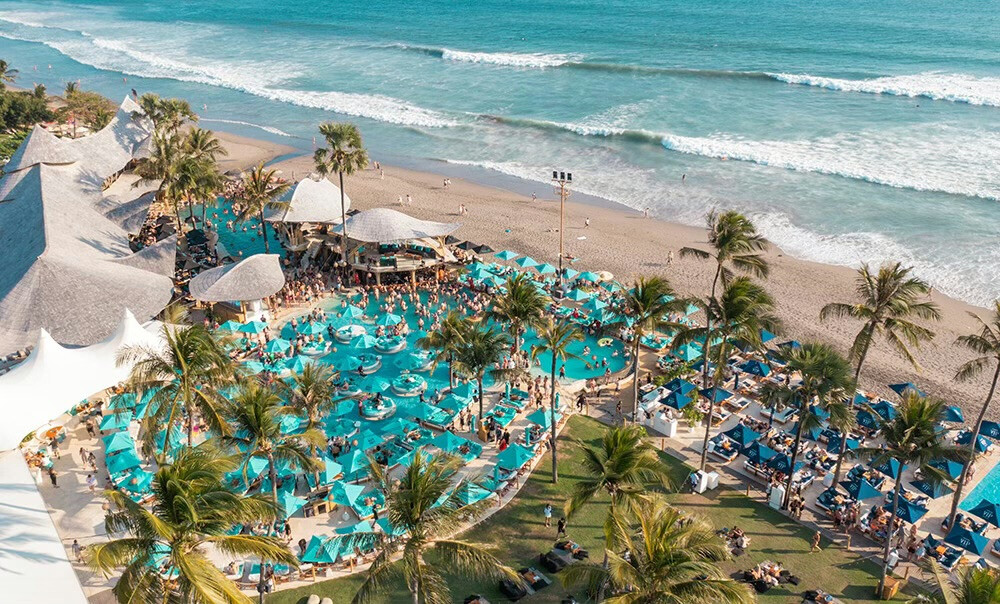
The subject of the new dispute is the ANDAL and RKL-RPL documents. PT Pantai Semara Nusantara, the company managing this tourist complex, submitted them for the further development of the restaurant and related infrastructure.
ANDAL is an environmental impact assessment. RKL-RPL are environmental risk management and monitoring plans. Without them, it is not legally possible in Indonesia to expand or modernize large facilities, especially in coastal areas.
On December 18, 2025, at the regional office of WALHI Bali, the country's largest environmental organization, it was officially stated: the documents cannot be deemed acceptable.
The main argument is water. The Finns Beach Club project relies entirely on deep underground wells. There are no alternatives. At full capacity, the facility requires about 659,440 liters every day. Given the already existing structural water shortage, this is an excessive load.

WALHI notes that the ANDAL documents themselves acknowledge the risk of groundwater level decline. But beyond that, there's nothing. There are no calculations of a safe withdrawal volume, no data on the rate of aquifer replenishment, no modeling of seawater intrusion. For coastal Berawa, this is critical. The decline in groundwater levels here directly leads to the salinization of wells by seawater.
Environmentalists emphasize: the declared 'mitigation' measures are formal in nature. They include no figures, no scenarios, no forecasts.
There is another risk — natural disasters. The environmental advocacy group KEKAL Bali points out that the project site is located in a flood, erosion, and tsunami zone. However, ANDAL is limited to general descriptions. The documents do not explain how dense construction will increase water runoff, reduce its absorption into the ground, and affect the coast. The flood analysis only concerns the facility itself and ignores the regional drainage system.
There is also a social aspect. WALHI and KEKAL explicitly state: the water deficit primarily affects local residents. Their wells are drying up and becoming saline. Businesses, meanwhile, can drill deeper or buy water. The ANDAL and RKL-RPL documents scarcely address this conflict.

In February 2025, the Bali Parliament (DPRD Bali) already recommended the temporary closure of Finns Beach Club due to incomplete permits. It then concerned administrative and environmental compliance issues. The current conflict is a continuation of the same story. The club operates, development continues, but basic environmental issues remain unresolved.
WALHI demands that Bali's Environmental Agency recognize the ANDAL and RKL-RPL documents as unacceptable, not grant an environmental permit, and stop the expansion of coastal infrastructure.
Sources: Bali Politika, BaliPost.

You can add one right now!