
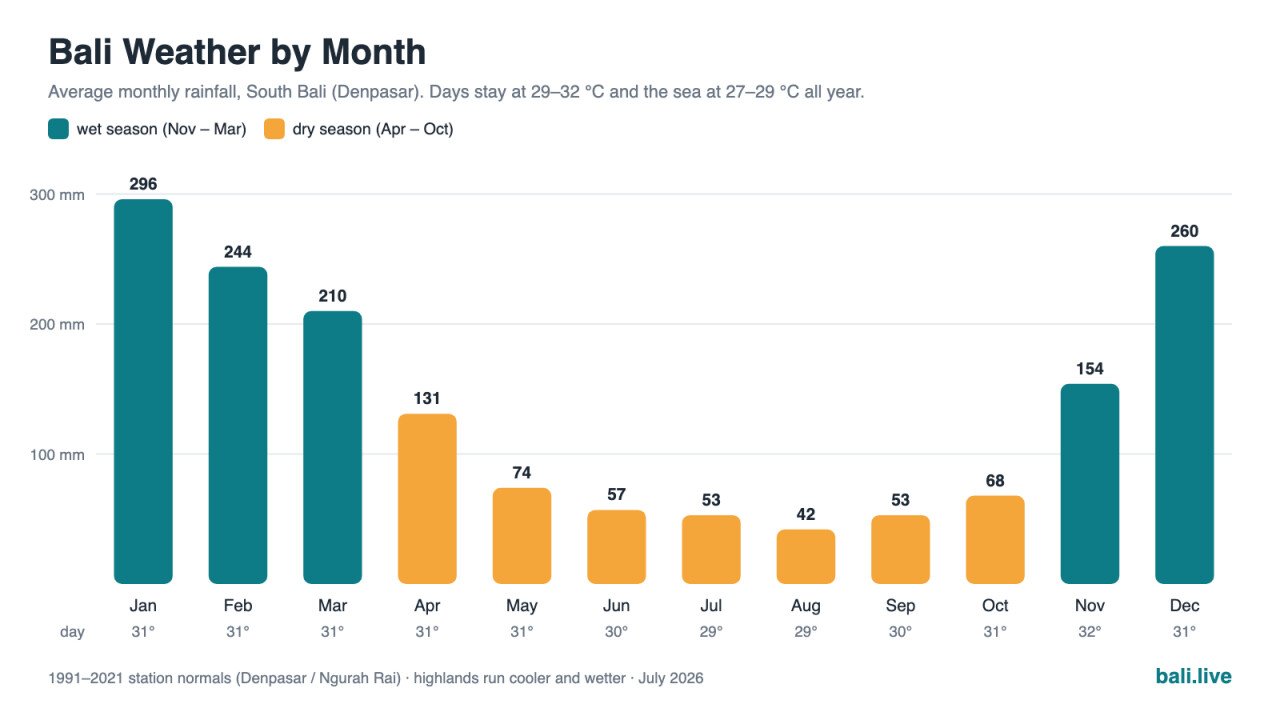
The short answer: the best time to visit Bali is the dry season, from April to October — and within it, May, June and September are the sweet spot, with dry sunny days, a warm sea and noticeably thinner crowds than the July–August peak. The cheapest, quietest months are February, March and early November; the wettest are December to February. And there is no genuinely bad month — the wet season simply trades sunshine for green landscapes, low prices and space to breathe.
Temperatures barely move all year: days around 29–32 °C, nights 23–25 °C, and the sea between 27 and 29 °C. So the real decision isn't hot versus cold — it's dry versus wet, and busy versus quiet. Here's how the year actually plays out.
Bali's Year at a Glance
- Dry season: April – October (driest months: July – September)
- Wet season: November – March (wettest: December – January — short heavy downpours rather than all-day rain)
- Busiest and priciest: July – August, plus the Christmas – New Year weeks
- Best weather-to-value ratio: May – June and September – October
- Cheapest and quietest: February, March, early November
- Swimmable all year: sea temperature stays at 27 – 29 °C
Bali Month by Month
January
Peak wet season: the rainiest stretch of the year (around 300 mm), high humidity, and rain that usually arrives as intense bursts with sunshine in between. Once the New Year crowd leaves in the first week, the island turns green, quiet and cheap. East-coast surf is at its best, and the waterfalls are thundering.
February
Still properly wet and the quietest full month of the year — the best prices you'll see. Chinese New Year (17 February 2026; 6 February 2027) brings a short burst of domestic and regional visitors. From 2027, Ramadan also begins in early February.
March
The monsoon starts tapering off — and mid-March needs planning in both 2026 and 2027. Nyepi, Bali's Day of Silence, falls on 19 March 2026 and 9 March 2027: for 24 hours the whole island stops and even the airport closes. Idul Fitri follows almost immediately (≈20 March 2026; 10 March 2027), bringing a wave of Indonesian holidaymakers. On the upside, the rice terraces at Jatiluwih are at their greenest.
April
The transition month: rainfall drops sharply and the sun takes over, while crowds stay moderate outside the Easter school-holiday window (early-to-mid April for most Australian states). One caveat: Mount Agung sunrise treks usually close for several weeks around late March – April for the Besakih temple ceremonies — check before booking.
May
The start of prime time: dry, warm, uncrowded and cheaper than mid-year. Light shoulder-season winds mean both surf coasts can work at once, and manta-ray activity around Nusa Penida is near its usual peak. One of the two best all-round months of the year.
June
Dry, marginally cooler, and building toward the peak — the Australian mid-year school break begins in the last week. Galungan and Kuningan fall on 17 and 27 June 2026, when streets across the island fill with tall penjor bamboo poles: a beautiful time to be here. The Bali Arts Festival in Denpasar runs from mid-June to mid-July.
July
Peak season, part one. The coolest weather of the year, among the driest — and the biggest crowds. Western Australia's school break starts earlier than the eastern states' and the two overlap, so the whole month is effectively Australian family season. Expect premium prices (a villa can run 40–80% above its September rate) and the year's worst traffic: the airport–Ubud transfer can stretch to 2.5–3.5 hours. Book 4–6 months ahead. West-coast surf is world-class — and busy.
August
Peak season, part two, and statistically the driest month of the year. Everything said about July applies: superb weather, big crowds, top prices. Mola-mola season around Nusa Penida heads toward its peak. In 2027, Galungan returns on 11 August (Kuningan on 21 August).
September
The insider's favourite. Still dry, sea still warm, the August crowd gone, prices down — and the rice terraces around Ubud turn gold after harvest. For Australian families it's the cheapest school-holiday window of the year (late September into early October). If you can only pick one month, September makes a very strong case.
October
The tail of the dry season: a touch more humid, with the first real rains late in the month, but still mostly sunny and good value. Waterfalls begin refilling without daily downpours, and light winds can open both surf coasts. The last comfortable window before the monsoon.
November
The wet season eases in — often more gently than its reputation suggests, especially early in the month. Prices are low and beaches quiet until the festive surge begins in December. East-coast surf switches on. A good bet for budget travellers who don't mind an afternoon shower.
December
Among the wettest months of the year, neck-and-neck with January — and from mid-month, one of the busiest. The Christmas–New Year stretch is the single most expensive week of the year, with the heaviest traffic in the south. Coming for the festive season? Book months ahead and pack for the odd downpour.
When to Come for What You Love
Surfing
Bali's surf follows the wind. In the dry season (April – October) the south-east trades blow offshore on the west coast — Uluwatu, Padang Padang, Bingin, Canggu — with the biggest, most powerful swells in July – August. In the wet season the winds flip and the east coast fires instead: Keramas, Nusa Dua, Sanur, with cleaner, friendlier waves and glassy, uncrowded mornings. The shoulder months (April – May and October – November) often serve both coasts at once.
Diving and snorkelling
Manta rays cruise Nusa Penida all year, with activity typically peaking March – June. The famous mola-mola (ocean sunfish) season runs July – October, peaking August – September — which is also when the seas are at their roughest, so allow for the occasional cancelled fast-boat crossing. The calmest, most beginner-friendly conditions run November – May.
Waterfalls
Fullest and most dramatic during and just after the rains, roughly December – April — just expect murky water and slippery trails right after a storm. October is a nice compromise: the flow is rebuilding but the downpours aren't daily yet. In the late dry season the falls run clear but low.
Volcano sunrises
Mount Batur and Mount Agung treks are at their best April – October, with the most reliable clear dawns in July – August — bring a jacket, as summit mornings run 12–16 °C. Agung usually closes for several weeks around late March – April for temple ceremonies, and every trail closes on Nyepi.
Rice terraces
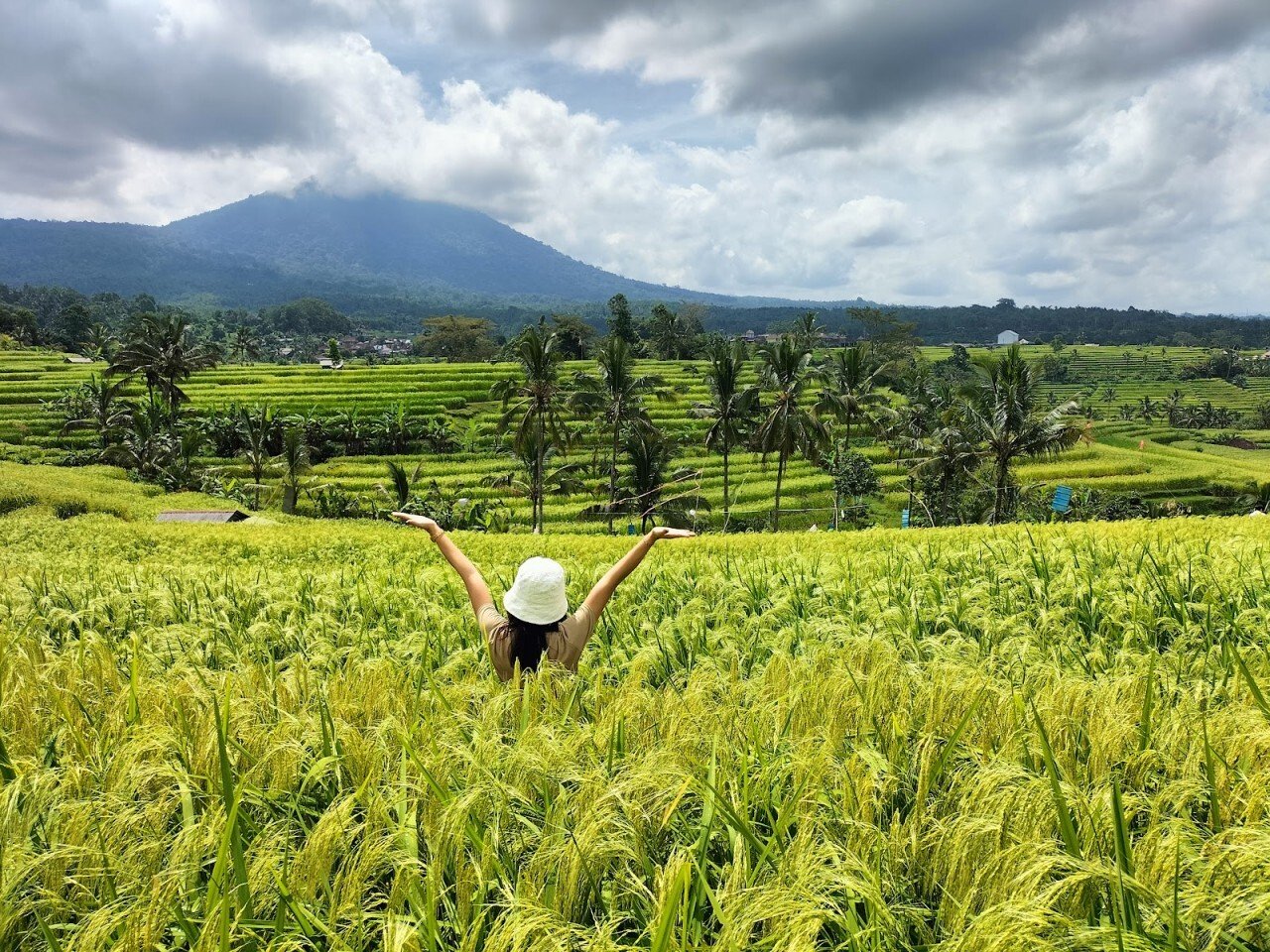
Greenness follows the planting cycle, not just the rain: Jatiluwih is at its lushest roughly February – April, while the terraces around Ubud glow gold right after the September harvest.
Crowds, Prices and When to Book
Two windows drive Bali's prices — the July–August school-holiday peak and the Christmas–New Year weeks. Around them, costs fall away quickly:
- July – August: villas commonly run 40 – 80% above their September rates; book 4 – 6 months ahead
- Christmas – New Year: the most expensive seven days of the year — often more than double September rates — plus the year's heaviest traffic
- Cheapest flights from Australia: February, March, late October and early November
- September: the value pick among school-holiday windows — 6 – 8 weeks of booking lead time is usually enough
- On the ground: warung meals, drivers and entry fees barely change with the season — it's flights and beds that swing
Dates to Plan Around in 2026 – 2027
- Nyepi (Day of Silence): 19 March 2026 · 9 March 2027 — the island shuts down completely for 24 hours, airport included; the Ogoh-ogoh demon parades the evening before are a genuine highlight
- Idul Fitri (Lebaran): ≈20 March 2026 · 10 March 2027 (moon-dependent, can shift a day) — a nationwide holiday with a surge of domestic travel
- Galungan & Kuningan: 17 / 27 June 2026; in 2027 twice — 13 / 23 January and 11 / 21 August
- Chinese New Year: 17 February 2026 · 6 February 2027 — a short regional-visitor spike
- Bali Arts Festival (Denpasar): mid-June to mid-July each year (the 2026 edition is reported for ~13 June – 11 July)
- Also on the calendar: Waisak (31 May 2026 · 20 May 2027), Idul Adha (27 May 2026 · 17 May 2027), Indonesian Independence Day (17 August)
Note that in both 2026 and 2027, Nyepi and Idul Fitri land back-to-back in mid-March — a total island shutdown followed immediately by a domestic-travel spike. It's a fascinating window culturally, but not the week for a tight itinerary.
The Honest Downsides
Trash season. From roughly December to March, the monsoon's westerly currents wash plastic and debris onto the south-west beaches — Kuta, Legian, Seminyak and Canggu can look genuinely dirty on some mornings, and clean-up crews work daily. The east coast (Sanur, Nusa Dua) stays much cleaner, as do all beaches through the dry season.
Wet-season rain is real rain. Most days it's a loud hour or three rather than a write-off — but a big December downpour can flood the lanes of Canggu and Seminyak and briefly stall traffic. Build slack into wet-season plans.
Peak-time traffic. In July, August and the festive weeks, southern Bali's roads crawl. If you land in peak season, plan transfers outside rush hours and don't schedule anything tight on arrival day.
Best Month by Traveller Type
- Families: September — dry, cheaper, post-peak, and the terraces are golden
- Surfers: May – June and September for the west coast without peak crowds; the wet season's east coast for mellower waves
- Divers: July – October for mola-mola; March – June for peak manta activity
- Couples and honeymooners: May – June — dry, warm and calm before the rush
- Budget travellers: February – March or early November — the island at its cheapest and quietest
- First-timers who want a bit of everything: May or September
Coming in the rainy months anyway? Read our honest take on what Bali's rainy season really feels like. Planning your food adventures? See which fruit is in season month by month. And if you're still at the map stage, start with where Bali is and how to get here.
Climate figures are 1991–2021 station normals for South Bali (Denpasar / Ngurah Rai airport); highland areas such as Ubud, Munduk and Kintamani run cooler and wetter. Islamic holiday dates follow moon sightings and can shift by a day. Last checked: July 2026.
You can add one right now!